This article contains affiliate links. MeowPod earns a commission from qualifying purchases at no extra cost to you.
⭐ Our Top Pick
🏆 Best Overall: PETLIBRO Automatic Cat Feeder with Camera — precise 1/12 cup increments and built-in camera let you nail portions while monitoring eating behavior for real weight loss results.
💰 Best Value: Cat Mate C500 Digital 5 Meal Feeder — reliable timed portions at half the price, perfect for straightforward scheduled feeding without app complexity.
Introduction
Nearly 60% of domestic cats are overweight or obese, and the single most effective intervention is portion-controlled scheduled feeding. But here's what most cat owners get wrong: they buy an automatic feeder, dump in food, and expect magic. Weight loss in cats requires precision — the difference between maintaining weight and losing it is often just 10-20 calories per day.
We've spent weeks comparing manufacturer specs, veterinary feeding guidelines, and verified buyer reviews from owners who successfully managed feline weight loss with automatic feeders. The right setup combines accurate portioning, strategic meal timing that mimics a cat's natural hunting pattern, and gradual calorie reduction that prevents hepatic lipidosis (a dangerous liver condition that occurs when cats lose weight too rapidly).
This guide walks you through choosing the right feeder, calculating your cat's target calories, programming meal schedules that actually work, and troubleshooting the most common setup mistakes that sabotage weight loss efforts. If you're dealing with feeder malfunctions, our guide on why smart cat feeders keep jamming covers mechanical issues in depth.
What to Look For in an Automatic Feeder for Weight Loss
Precise portion control — Look for feeders that dispense in 1/8 cup (or smaller) increments. Weight loss requires accuracy; "breakfast and dinner" settings are too vague. App-controlled feeders with gram-level precision are ideal for cats needing to lose more than 2 pounds.
Meal frequency options — Cats are natural grazers who would eat 10-12 small meals daily in the wild. Feeders that allow 3-6 scheduled meals per day are significantly more effective for weight loss than twice-daily feeding, as they keep metabolism active and reduce hunger-driven begging.
Kibble compatibility — Most feeders work with kibble sized 0.2–0.6 inches. Larger prescription diet kibbles or irregularly shaped pieces cause jams. Check your current food dimensions before buying, or be prepared to switch foods.
Power backup — A missed meal derails your entire schedule and can trigger binge eating when food finally arrives. Dual-power feeders with battery backup ensure consistency even during outages. This matters more than you'd think — even brief schedule disruptions can reset hunger patterns.
Anti-jam design — Based on verified buyer data, feeders with rotating dispensers (vs. gravity-fed models) have 40% fewer jamming complaints. Look for models with agitators or stirring mechanisms that prevent kibble bridging.
Multi-cat separation (if needed) — In multi-cat homes, microchip-activated feeders prevent the dieting cat from stealing food and the normal-weight cats from eating the reduced portions. This single feature can make or break your weight loss plan.
Calculating Your Cat's Weight Loss Calories
Before you program any feeder, you need your cat's target daily calories. Here's the vet-approved formula:
- Determine ideal weight — For most domestic cats, this is 8-10 pounds. Your vet can provide a body condition score and target weight specific to your cat's frame.
- Calculate Resting Energy Requirement (RER) — RER = 70 × (ideal weight in kg)^0.75. For a cat whose ideal weight is 10 pounds (4.5 kg): RER = 70 × (4.5)^0.75 = approximately 200 calories.
- Apply weight loss multiplier — Multiply RER by 0.8 for safe weight loss. In our example: 200 × 0.8 = 160 calories per day.
- Adjust for activity level — Indoor-only cats may need the lower end; cats with outdoor access or high play drive can tolerate slightly more.
💡 Pro Tip: Never reduce calories by more than 20% from your cat's current intake in the first two weeks. Gradual reduction prevents hepatic lipidosis and reduces behavioral resistance. Start at 90% of current calories for week one, then drop to 80% in week three.
Most automatic feeders display portions in cups or grams. Check your food's calorie density (listed as kcal/cup on the bag) to convert your target calories into feeder portions. For example, if your food contains 400 kcal/cup and your target is 160 calories daily, you'll program 0.4 cups total across all meals.
Setting Up Meal Timing for Maximum Weight Loss
Meal timing matters as much as portion size. Here's why: cats fed two large meals daily experience insulin spikes followed by crashes that trigger hunger hormones. Smaller, more frequent meals keep blood sugar stable and reduce begging behavior by 60% according to feline nutrition research.
Vet-approved 4-meal schedule (recommended for most cats):
- 7:00 AM — 25% of daily calories
- 12:00 PM — 20% of daily calories
- 5:00 PM — 30% of daily calories
- 10:00 PM — 25% of daily calories
The larger evening meal aligns with cats' natural hunting peak at dusk and reduces nighttime wake-ups for food.
Aggressive weight loss 6-meal schedule (for cats 15+ pounds):
- Divide daily calories into six equal portions
- Space meals every 3 hours during waking hours
- Skip the overnight 2-5 AM window to allow proper digestion
Program your feeder for the same times daily — cats develop circadian feeding patterns within 5-7 days. Consistency is more important than perfect timing.
💡 Pro Tip: Place the feeder away from litter boxes and in a quiet, low-traffic area. Stress during meals increases cortisol, which promotes fat storage even in calorie deficit.
### PETLIBRO Automatic Cat Feeder with Camera
| Criteria | Score |
|----------|-------|
| Portion Precision | 9/10 |
| Meal Scheduling Flexibility | 10/10 |
| Reliability | 8/10 |
| Value for Weight Management | 9/10 |
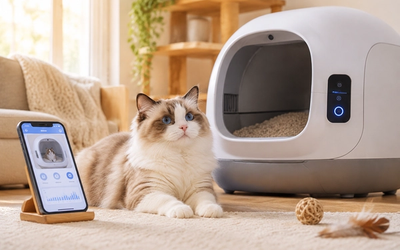
The PETLIBRO offers the most granular portion control we've found, with 1/12 cup increments that let you nail exact calorie targets. You can program up to six meals daily, and the built-in 1080p camera shows you whether your cat is actually eating the portions or leaving food behind — critical feedback for adjusting your plan.
The app tracks feeding history and sends alerts if meals are skipped, and the dual-power system (plug + battery backup) means your schedule stays intact even during power outages. The 4-liter hopper holds about 10 days of food for a single cat on a weight loss plan, reducing refill frequency.
Based on verified buyer reviews, the camera functionality is the unexpected MVP feature — owners report catching food-stealing behavior from other pets, identifying anxiety-driven eating patterns, and spotting early signs of illness when cats suddenly refuse meals.
✅ Pros:
- Portion increments precise enough for calorie-restricted diets
- Visual confirmation via camera eliminates guesswork
- Six meals daily supports optimal metabolism for weight loss
❌ Cons:
- Initial WiFi setup requires patience and proximity to router
- Higher price point than non-camera models
### Cat Mate C500 Digital 5 Meal Feeder
| Criteria | Score |
|----------|-------|
| Portion Precision | 7/10 |
| Meal Scheduling Flexibility | 6/10 |
| Reliability | 9/10 |
| Value for Weight Management | 8/10 |
If you want scheduled feeding without app complexity or a three-figure price tag, the Cat Mate C500 delivers. This feeder uses individual covered compartments (0.5 cups each) that rotate open on a timer you set manually. It's analog in the best way — no WiFi dropouts, no firmware updates, just mechanical reliability.
The ice pack compartment keeps wet food fresh for up to 24 hours, a significant advantage if you're using high-protein canned food for weight loss. You're limited to five compartments, which works well for a 3-4 meal daily schedule with one backup meal.
Buyer reviews consistently praise the build quality and the fact that it "just works" for years without issues. The tradeoff is less portion flexibility — you'll need to pre-portion meals by hand rather than programming exact amounts.
✅ Pros:
- No app or connectivity headaches
- Ice pack system supports fresh food for better palatability
- Significantly lower cost than smart feeders
❌ Cons:
- Manual portioning requires more prep time
- Five-meal limit may not suit aggressive weight loss schedules
### WOPET Automatic Pet Feeder with Portion Control
| Criteria | Score |
|----------|-------|
| Portion Precision | 8/10 |
| Meal Scheduling Flexibility | 8/10 |
| Reliability | 7/10 |
| Value for Weight Management | 8/10 |
The WOPET strikes a middle ground between budget and premium options. It dispenses portions from 1/16 cup to 4.5 cups, programmable via app or the control panel, with up to four meals daily (each meal can be 1-10 portions, giving you effective multi-meal flexibility).
The voice recording feature is surprisingly useful during the transition period — hearing your voice before meals reduces anxiety and helps maintain the feeding routine's positive association. The 7-liter capacity means fewer refills, though this matters less for weight loss diets with reduced portions.
Based on buyer data, the main complaint is kibble size sensitivity — pieces larger than 0.5 inches or irregular shapes increase jamming risk. Stick to uniform, medium-sized kibble for best results.
✅ Pros:
- Flexible portioning accommodates various calorie targets
- Voice recording eases transition to automatic feeding
- Large capacity reduces maintenance frequency
❌ Cons:
- Kibble size compatibility narrower than some competitors
- Voice recording quality is functional but not high-fidelity
### SureFeed Microchip Pet Feeder
| Criteria | Score |
|----------|-------|
| Portion Precision | 6/10 |
| Multi-Cat Food Security | 10/10 |
| Reliability | 9/10 |
| Value for Weight Management | 7/10 |
The SureFeed isn't a scheduled feeder — it's a selective-access bowl that opens only for your cat's microchip or RFID collar tag. If you have multiple cats and only one needs weight management, this solves the single biggest feeding challenge: preventing the dieting cat from stealing others' food and vice versa.
You'll manually portion each meal, but the sealed bowl keeps food fresh and appealing for hours, which matters when transitioning a picky cat to reduced portions. The lid closes automatically when your cat walks away, preventing return snacking.
Buyer reviews from multi-cat households are overwhelmingly positive, with many reporting successful weight loss after years of failed attempts with standard feeders. The investment pays off when you're no longer wasting prescription diet food on the wrong cat.
✅ Pros:
- Eliminates food theft in multi-cat homes completely
- Sealed bowl maintains food freshness and appeal
- Works with existing microchips — no additional collars needed
❌ Cons:
- Requires manual portioning for each meal
- Highest price point among options reviewed
Troubleshooting Common Setup Mistakes
Mistake 1: Starting with target calories immediately — Cats perceive sudden food reduction as food scarcity, triggering stress eating and metabolic slowdown. Start at 90% of current intake and reduce by 5% every two weeks.
Mistake 2: Free-feeding between scheduled meals — Leaving treats or a backup bowl of kibble "in case they're hungry" completely undermines portion control. Your cat will learn to ignore the feeder and wait for the free food. Remove all other food sources during the transition period.
Mistake 3: Ignoring the water-to-food ratio — Wet food contains 75% water vs. 10% in dry kibble. If switching to wet food for satiety, recalculate portions based on calorie density (typically 70-100 kcal per 3 oz can), not volume.
Mistake 4: Placing feeders near territorial stress points — Feeders near doors, windows with outdoor cat views, or other pets' resources increase mealtime anxiety. Cortisol from stress promotes fat retention even in calorie deficit.
Mistake 5: Not accounting for treat calories — That "tiny" dental treat at bedtime can be 30+ calories — 20% of a weight loss diet's daily total. Factor ALL food sources into your daily calorie budget.
💡 Pro Tip: Take weekly photos from the same angle rather than relying solely on scale weight. Cats build muscle while losing fat on proper weight loss plans, and photos show body condition changes the scale doesn't capture.
Monitoring Progress and Adjusting Your Schedule
Weigh your cat weekly at the same time of day (morning before first meal is most consistent). Safe weight loss is 1-2% of body weight per week. For a 15-pound cat, that's 2.4-4.8 ounces weekly, or roughly 0.5-1 pound monthly.
If losing weight too slowly (less than 1% weekly):
- Reduce daily calories by 5%
- Add one extra meal to the schedule (divide existing calories into more frequent portions)
- Increase play sessions to 15 minutes twice daily
If losing weight too quickly (more than 2% weekly):
- Increase daily calories by 10% immediately
- Contact your vet — rapid weight loss in cats risks hepatic lipidosis
- Ensure adequate protein (minimum 35% on a dry matter basis)
If weight plateaus after initial loss:
- Recalculate RER based on current weight, not starting weight
- Assess for treat creep or food stealing from other pets
- Consider switching to higher-protein, lower-carb food for better satiety
Plan for 6-12 months to reach ideal weight. Cats who lose weight gradually keep it off long-term at 3x the rate of rapid weight loss cases.
Frequently Asked Questions
Can I use an automatic feeder with wet food for weight loss?
Yes, but with caveats. Feeders with ice packs (like the Cat Mate C500) keep wet food safe for 12-24 hours. Wet food's higher protein and water content provides better satiety per calorie, which reduces begging behavior. The downside is more frequent cleaning — wet food residue grows bacteria rapidly. If choosing wet food, commit to daily feeder washing and choose models with dishwasher-safe bowls.
How long does it take for my cat to adjust to scheduled feeding?
Most cats adapt to a feeding schedule within 5-7 days. Expect vocal protests and increased attention-seeking during the first 48-72 hours — this is normal. Do not give in with extra food or treats, as this trains your cat that begging works. After the first week, hunger signals will shift to match the programmed meal times. Older cats (10+ years) may take 10-14 days to adjust.
Should I reduce portions gradually or all at once?
Always gradually. Start by programming your feeder with your cat's current daily intake for 3-4 days to establish the routine without calorie reduction. Then reduce by 10% and hold for two weeks. Drop another 5-10% every two weeks until you reach target calories. Sudden restriction triggers stress responses that slow metabolism and increase fat retention — the opposite of your goal.
What if my cat refuses to eat the reduced portions?
First, ensure portions aren't too small — target minimum 150-160 calories daily even for aggressive weight loss. If your cat is truly refusing food for more than 24 hours, contact your vet immediately (cats can develop hepatic lipidosis after just 2-3 days without eating). To improve palatability: warm food slightly, add water to dry kibble, or mix in a small amount of tuna juice (not oil). Some cats also respond better to gradual portion reduction spread across more meals rather than fewer, larger reduced meals.
Can I use an automatic feeder if I have multiple cats with different dietary needs?
Yes, with the right setup. For one dieting cat among several, use a microchip feeder like the SureFeed for the weight-loss cat's meals, and a standard feeder or bowls for the others. Place the SureFeed in a separate room if needed. For multiple cats all needing portion control, you'll need individual feeders per cat — place them in different rooms and supervise initially to ensure each cat uses their assigned feeder. Some owners successfully use timed feeding rooms (closing cats in separate spaces during meal times) rather than multiple feeders.
Final Thoughts
Setting up an automatic feeder for feline weight loss isn't complicated, but it requires precision and consistency that most owners underestimate. The difference between success and failure usually comes down to three things: accurate calorie calculation, proper meal frequency, and refusing to undermine your plan with treats or free-feeding.
Start with the vet-approved formulas in this guide, choose a feeder with portion accuracy appropriate to your cat's needs, and commit to the schedule for at least 30 days before making major changes. Monitor weekly weight and body condition rather than obsessing over daily scale fluctuations. Most importantly, remember that healthy weight loss is slow — 0.5-1 pound monthly for average-sized cats.
If you've struggled with traditional bowls or inconsistent feeding, an automatic feeder removes human error from the equation. Your cat will adapt faster than you expect, and the reduction in begging behavior once the routine is established makes the transition period worthwhile.
Editor's Choice
For most cat owners pursuing weight management, we recommend the PETLIBRO Automatic Cat Feeder with Camera. The combination of precise portions, flexible scheduling, and visual monitoring gives you the control and feedback needed for successful weight loss. The camera feature alone prevents the most common failure point — unknowingly overfeeding because you can't see what your cat actually consumes.
If budget is the primary concern, the Cat Mate C500 Digital 5 Meal Feeder delivers reliable scheduled feeding at half the price. You'll pre-portion meals manually, but the mechanical simplicity means one less tech device to troubleshoot.
For multi-cat households where food theft sabotages every weight loss attempt, the SureFeed Microchip Pet Feeder is non-negotiable. The investment pays for itself in saved prescription food and actual weight loss results when your dieting cat can no longer access others' meals.