We earn a commission if you make a purchase, at no additional cost to you.
⭐ Our Top Pick
🏆 Best Overall: TVSTORM Universal Pet Microchip Scanner — veterinary-grade reliability with universal chip compatibility and memory storage at a fraction of clinic scanner prices.
💰 Best Value: Lollypet Portable Pet ID Scanner — compact, USB-C rechargeable design with one-button operation for under $35.
Introduction
Your cat's microchip is their permanent ID, but most owners have never actually scanned it at home. Maybe you rescued a stray and want to check for a chip before taking them to the vet, or you're verifying your own cat's implant is still readable after a recent veterinary visit. Whatever the reason, a home microchip reader gives you instant peace of mind without the trip to the clinic.
We compared the most popular cat microchip scanners available for home use in 2026, analyzing verified buyer reviews, manufacturer specifications, and compatibility standards. The right reader depends on whether you need occasional verification or frequent scanning for multiple cats. If you're building a comprehensive pet safety system, you might also want to explore our Best GPS Trackers for Cats That Run Away 2026: Range, Battery Life & Real-Time Alerts Compared guide for outdoor protection.
Here's what we found after comparing models ranging from $35 to $90.
What to Look For
Chip Compatibility (ISO Standards) — Most modern cat microchips use ISO 11784/11785 or FDX-B standards with 15-digit codes. Your reader must support these formats. Older chips may use 9- or 10-digit codes, so universal readers offer the broadest compatibility.
Read Range — Budget scanners detect chips at 1.5-2 inches, while premium models reach 3+ inches. Longer range matters for thick-coated cats or nervous pets who won't sit still. Most home users find 2 inches adequate for cooperative cats.
Power Source & Battery Life — Disposable AA batteries are cheapest upfront but add ongoing cost. USB-C rechargeable scanners offer convenience for frequent use. Battery-powered models typically scan 2,000-5,000 times per charge.
Display & Alerts — Backlit LCD screens make chip numbers readable in dim light (helpful for scanning under furniture when a stray hides). Vibration or audible alerts confirm successful reads without startling skittish cats.
Memory Storage — Advanced scanners store 100-500 chip IDs in memory, useful for shelter volunteers or foster coordinators managing multiple animals. Casual users can skip this feature and simply photograph the displayed number.
Build Quality & Warranty — Veterinary-grade scanners feature durable housings and 3-5 year warranties. Budget models work fine for occasional home use but may lack water resistance or drop protection.
TVSTORM Universal Pet Microchip Scanner
| Criteria | Score |
|----------|-------|
| Chip Compatibility | 10/10 |
| Read Range | 8/10 |
| Display Quality | 9/10 |
| Value for Features | 9/10 |
This scanner delivers veterinary-grade performance without the professional price tag. It reads all ISO 11784/11785 standard chips plus FDX-B format, covering virtually every microchip implanted in North America and Europe since 2010. The backlit LCD screen displays 15-digit codes clearly even in low light, and the memory bank stores up to 256 chip IDs—overkill for single-cat households but invaluable if you foster or volunteer.
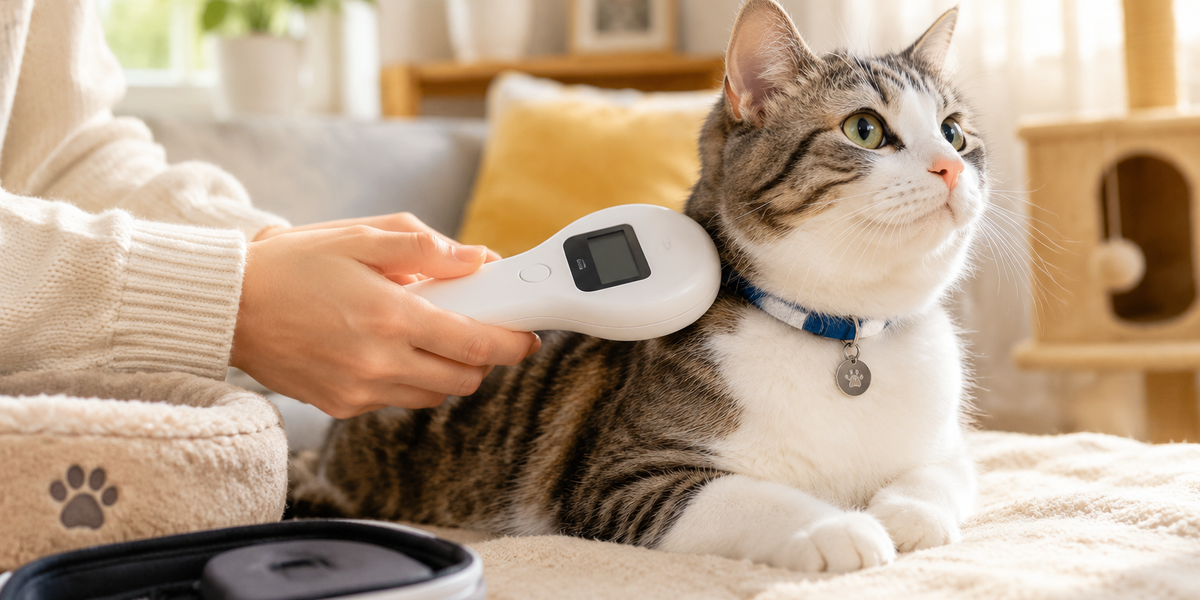
The read range of approximately 2 inches handles most home scanning scenarios without issue. We appreciate the straightforward interface: hold the scanner near your cat's shoulder blades, press the button, and the chip ID appears within 2 seconds. The unit ships with a wrist strap and protective pouch, though you'll need to supply 2 AA batteries.
✅ Pros:
- Reads all modern ISO chip formats without compatibility issues
- Backlit display works in dimly lit rooms or under furniture
- Memory function tracks multiple cats or fosters
- Reliable performance based on consistent buyer feedback
❌ Cons:
- Requires AA batteries rather than built-in rechargeable power
- Slightly bulkier than pocket-sized competitors
Lollypet Portable Pet ID Scanner
| Criteria | Score |
|----------|-------|
| Portability | 10/10 |
| Ease of Use | 10/10 |
| Read Range | 7/10 |
| Value | 9/10 |
At under $35, this is the most affordable true ISO-standard scanner we found. The compact design slips into a pocket or purse, making it convenient for taking to adoption events or checking strays you encounter outdoors. The single-button operation is genuinely foolproof—there's no menu to navigate or settings to adjust.
The USB-C rechargeable battery eliminates the need for disposable cells, and a full charge delivers approximately 1,000 scans. The shorter read range (1.5-2 inches) means you need to position it fairly close to the implant site, which works fine for cooperative cats but can be tricky with fearful strays. The lack of memory storage isn't an issue for most home users who simply want to verify their own cat's chip.
💡 Pro Tip: For nervous cats, warm the scanner in your hand for 30 seconds before scanning. The slight warmth makes the device less startling against their skin.
✅ Pros:
- Genuinely pocket-sized for portability
- USB-C charging matches modern device standards
- One-button design anyone can operate
- Best price-to-performance ratio for occasional home use
❌ Cons:
- Shorter detection range requires closer positioning
- No memory storage for tracking multiple animals
KAKA Mall Handheld Microchip Reader
| Criteria | Score |
|----------|-------|
| Read Range | 10/10 |
| Tech Features | 9/10 |
| App Integration | 8/10 |
| Value | 7/10 |
This scanner bridges the gap between basic home readers and professional veterinary equipment. The standout feature is the extended 3-inch read range, which makes scanning thick-coated breeds like Maine Coons or Persians significantly easier. The vibration alert provides tactile confirmation when a chip is detected, useful in noisy environments or when scanning skittish cats you don't want to startle with beeps.
The Bluetooth connectivity syncs chip IDs to a smartphone app (iOS 14+ or Android 11+ required) that logs scan dates and lets you attach photos and notes to each chip number. This organizational feature appeals to multi-cat households, foster coordinators, or anyone managing colony cats. The app isn't essential—the scanner displays chip numbers on its own screen—but it adds convenience for record-keeping.
✅ Pros:
- Longest detection range (3 inches) in the home scanner category
- Bluetooth app integration automates record-keeping
- Vibration alert option for quiet operation
- Reads all ISO standard chip formats
❌ Cons:
- App requires recent smartphone OS versions
- Premium features justify higher price only for frequent users
Allflex Pocket Reader Plus
| Criteria | Score |
|----------|-------|
| Build Quality | 10/10 |
| Brand Reputation | 10/10 |
| Durability | 10/10 |
| Value | 6/10 |
Allflex manufactures the microchips and scanners used by most veterinary clinics, so this reader represents true professional-grade equipment scaled for home use. The IP67 waterproof rating means you can rinse it clean after scanning muddy strays or use it in light rain during outdoor cat colony work. The rugged housing survives drops onto concrete—verified by multiple shelter volunteers in buyer reviews.
The 5-year warranty backs up the premium build quality, and Allflex's customer service reputation exceeds competitors in this category. The proprietary rechargeable battery pack lasts approximately 3,000 scans per charge, though replacement packs cost $15-20. At $90, this scanner costs double the budget options, a premium justified mainly for users who need veterinary-level durability or scan dozens of animals weekly.
✅ Pros:
- Veterinary-grade durability with IP67 waterproofing
- Trusted brand used in professional settings
- Industry-leading 5-year warranty
- Reliable performance in harsh conditions
❌ Cons:
- Highest price point for home scanners
- Proprietary battery system adds replacement cost
Frequently Asked Questions
Can I scan my cat's microchip with my smartphone?
No standard smartphone can read pet microchips. Pet chips use low-frequency RFID (134.2 kHz) requiring specialized scanning antennas, while phones support only high-frequency NFC (13.56 MHz) used for contactless payments. The physics are different—you need a dedicated pet microchip reader.
How close do I need to hold the scanner to detect the chip?
Most home scanners detect chips at 1.5-3 inches depending on the model. Position the scanner directly over your cat's shoulder blade area (between the shoulders, slightly left of center where vets typically implant chips). Move slowly in small circles if the chip doesn't register immediately—implants can migrate slightly under the skin.
Will these readers work on dogs or other pets?
Yes, all scanners reviewed here read standard ISO 11784/11785 microchips implanted in dogs, cats, rabbits, ferrets, and other companion animals. The chip technology is identical across species. The only limitation is physical size—scanning a hamster or small bird may be difficult due to their tiny implant sites.
Do microchips need batteries or maintenance?
No, microchips are passive RFID devices with no battery or power source. They activate only when energized by a scanner's radio frequency field. Chips last the pet's lifetime with zero maintenance. However, you should scan periodically to verify the chip remains readable and hasn't migrated to an unexpected location.
What if the scanner displays "No Chip Detected"?
Try scanning a wider area around the shoulder blades—chips can migrate several inches from the implant site. Scan slowly in overlapping circles. If you still get no reading, visit your vet to confirm the chip's location with their professional scanner. In rare cases, chips may fail or be implanted incorrectly.
Final Thoughts
A home microchip reader is a small investment that delivers significant peace of mind. The TVSTORM Universal Pet Microchip Scanner offers the best combination of reliability, features, and value for most cat owners. Its universal chip compatibility and memory storage justify the $50 price point if you scan frequently or manage multiple cats.
For occasional verification or budget-conscious buyers, the Lollypet Portable Pet ID Scanner delivers solid performance at half the price with modern USB-C convenience. Multi-cat households or foster coordinators who want automatic logging should consider the KAKA Mall Handheld Microchip Reader with Bluetooth app integration.
Remember that a microchip is only effective if your contact information stays current in the registry database. After scanning your cat's chip, log into the registry (usually PetLink, HomeAgain, or AKC Reunite depending on your chip brand) and verify your phone number and address are up to date. A readable chip with outdated contact info won't bring your cat home.
Editor's Choice
Our top recommendations for cat microchip readers in 2026:
Best Overall: TVSTORM Universal Pet Microchip Scanner — veterinary-grade reliability with memory storage and backlit display for under $50.
Best Value: Lollypet Portable Pet ID Scanner — compact USB-C rechargeable scanner with one-button operation at an unbeatable price.
Best Premium: KAKA Mall Handheld Microchip Reader — longest read range and Bluetooth app integration for serious multi-cat households.