We earn a commission if you make a purchase, at no additional cost to you.
⭐ Our Top Pick
🏆 Best Overall: Frisco 72-Inch Cat Tree — the most complete vertical territory solution that combines climbing, scratching, and resting zones in one sturdy unit.
💰 Best Value: Catit Senses 2.0 Food Tree — an affordable puzzle feeder that delivers mental enrichment and slows eating for under $25.
Introduction
Setting up a dedicated cat room transforms your home from a shared space into an environment intentionally designed around your cat's natural behaviors. Whether you're converting a spare bedroom, home office, or laundry room, a well-planned cat room provides safety during your absence, reduces territorial stress in multi-pet households, and concentrates enrichment resources where they'll actually get used.
We've compiled this checklist after comparing dozens of product categories and layout strategies based on verified buyer feedback and manufacturer specifications. The goal isn't to recreate a pet store in your home — it's to establish functional zones that support your cat's core needs: vertical territory, safe elimination, mental stimulation, and secure rest. First-time owners often over-purchase or misplace essentials, so we'll walk through what actually matters and where it should go.
If you're working with limited square footage, our guide on how to set up a cat room in a studio apartment covers space-saving strategies and multi-functional furniture that apply to rooms of any size.
What to Look For
Vertical Territory Over Floor Space — Cats feel safest when they can survey their environment from above. Prioritize cat trees, wall-mounted shelves, or window perches over sprawling horizontal toys. A 6-foot vertical structure provides more psychological value than three floor-level scratchers.
Litter Box Accessibility and Privacy — The box should be visible enough that your cat knows where it is, but secluded enough to feel safe during use. Avoid corners that trap odor or locations near noisy appliances. Plan for one box per cat, plus one extra if space allows.
Distinct Rest Zones — Cats cycle through 12-16 hours of sleep daily and prefer multiple nap locations. Provide at least two resting options: one elevated (cat tree platform, shelf bed) and one ground-level (heated bed, enclosed cave). This accommodates temperature preferences and mood variation.
Enrichment That Mimics Hunting — Puzzle feeders, treat-dispensing toys, and rotation-friendly wand toys satisfy predatory instincts indoor cats can't otherwise express. Budget for items that require problem-solving, not just passive batting.
Safe Window Access — Windows deliver hours of passive entertainment through bird-watching and environmental monitoring. If your room has a window, install a secure perch or pad. For safety details on preventing falls and securing screens, see our cat-proofing guide for small apartments.
Cable and Hazard Management — First-time owners underestimate cats' attraction to dangling cords and small objects. Use cable clips, cord concealers, and secure any items smaller than a marble. Remove toxic plants (lilies, pothos, sago palms) and anchor tall furniture to prevent tip-overs.
Frisco 72-Inch Cat Tree
| Criteria | Score |
|----------|-------|
| Height & Perching Options | 9/10 |
| Scratching Surface Area | 8/10 |
| Stability for Active Cats | 8/10 |
| Value for Multi-Level Design | 9/10 |
The Frisco 72-Inch Cat Tree anchors your cat room's vertical zone with six feet of climbing height, two enclosed cubbies, and sisal-wrapped posts that redirect scratching away from furniture. Buyer reviews consistently praise its stability even with multiple cats jumping simultaneously, and the neutral beige coloring blends into most room aesthetics. The top platform places your cat at eye level with door entrants, satisfying their instinct to monitor territory from above. Assembly requires a screwdriver and about an hour, but the modular design means you can rearrange platforms as your cat's preferences evolve.
When deciding between a cat tree and window perch for limited spaces, our comparison guide breaks down which structure delivers more value based on your room's layout and your cat's age.
✅ Pros:
- Multiple perching levels accommodate multi-cat households
- Sturdy construction with reinforced posts
- Includes scratching surfaces and hideaway cubby
❌ Cons:
- Large footprint requires dedicated floor space
- Assembly takes 45-60 minutes
PetSafe ScoopFree Complete Plus Self-Cleaning Litter Box
| Criteria | Score |
|----------|-------|
| Odor Control | 9/10 |
| Maintenance Reduction | 9/10 |
| Initial Cost vs. Convenience | 7/10 |
| Noise Level During Rake Cycle | 6/10 |
The PetSafe ScoopFree Complete Plus automates the least pleasant aspect of cat ownership with a rake system that sweeps waste into a covered trap 20 minutes after each use. Crystal litter absorbs urine and dehydrates solid waste, controlling odor for 2-3 weeks in single-cat households before tray replacement. The built-in health counter logs usage frequency, helping first-time owners detect early signs of urinary issues or behavioral changes. The hood and privacy screen reduce litter tracking, though the motor's 30-second rake cycle produces a low hum some cats initially find startling.
💡 Pro Tip: Place the ScoopFree against a wall with the hood facing outward to muffle rake noise and give your cat a clear entry path. Allow 3-5 days for your cat to adjust to the automated sound before switching completely from a traditional box.
✅ Pros:
- Automatic rake system reduces daily maintenance
- Crystal litter controls odor for weeks
- Health counter tracks usage patterns
❌ Cons:
- Higher upfront cost than traditional boxes
- Proprietary crystal trays increase ongoing costs
Catit Senses 2.0 Food Tree
| Criteria | Score |
|----------|-------|
| Mental Stimulation | 8/10 |
| Difficulty Adjustability | 9/10 |
| Durability | 8/10 |
| Value for Enrichment | 10/10 |
The Catit Senses 2.0 Food Tree transforms mealtime into a hunting simulation by requiring your cat to fish kibble through three adjustable difficulty levels. This slows eating speed (reducing vomiting in fast eaters), provides cognitive work that satisfies predatory instincts, and occupies cats during the day when owners are absent. The narrow tube design fits into corners or beside furniture, and the transparent sides let you monitor food levels. Buyer reviews note that cats who've never used puzzle feeders may need a week of gradual introduction, starting with the easiest setting and mixed with traditional bowl feeding.
✅ Pros:
- Slows eating to prevent vomiting
- Adjustable difficulty levels grow with your cat
- Compact footprint fits any room size
❌ Cons:
- Not suitable for wet food
- Requires initial training for puzzle-shy cats
K&H Pet Products Thermo-Kitty Heated Cat Bed
| Criteria | Score |
|----------|-------|
| Heating Efficiency | 9/10 |
| Washability | 8/10 |
| Safety Features | 9/10 |
| Comfort & Cushioning | 8/10 |
The K&H Thermo-Kitty Heated Bed creates a designated rest zone that cats instinctively seek out, especially during colder months or after high-energy play sessions. The 4-watt internal heater warms to your cat's natural body temperature (102°F) without overheating, and the orthopedic foam base supports joints for cats of all ages. The removable cover is machine washable, though you'll need to unplug and air out the heating element between washes. Position this bed in a quiet corner away from foot traffic to establish a retreat zone your cat associates with safety and rest.
✅ Pros:
- Low-wattage heating (4 watts) is safe and energy-efficient
- Removable cover is machine washable
- Orthopedic foam supports aging joints
❌ Cons:
- Cord must be routed safely to prevent chewing
- Some cats prefer unheated beds
Room Layout Zones
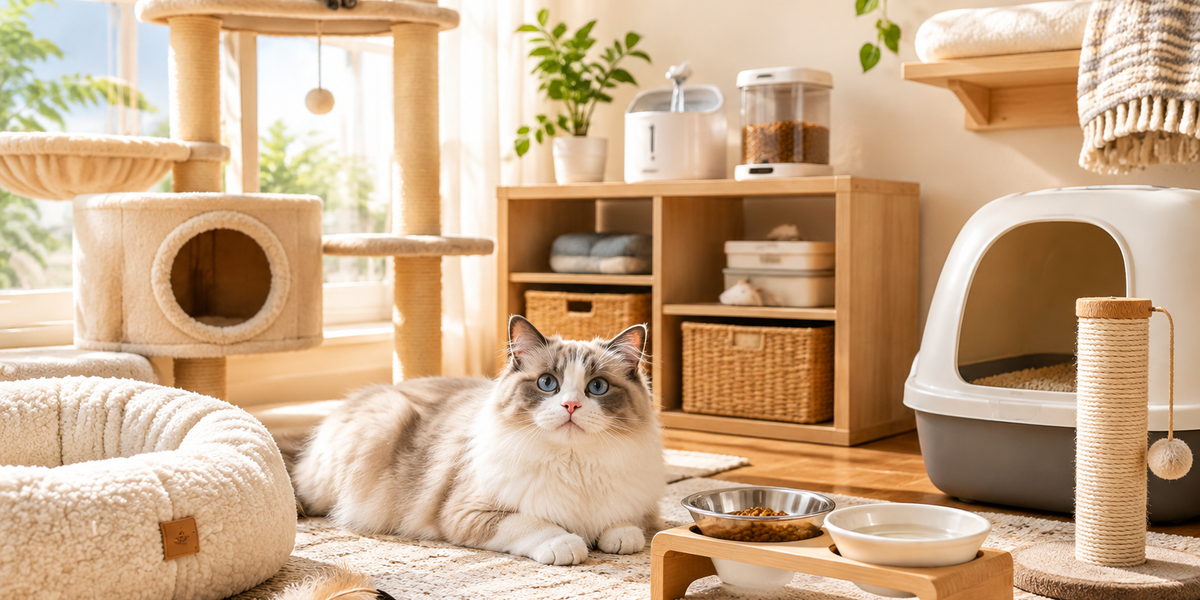
Activity Zone (High-Traffic Area) — Place the cat tree, puzzle feeders, and interactive toys near the room's entrance or main walkway. This encourages play during your visits and positions climbing structures where your cat can monitor door activity.
Elimination Zone (Low-Traffic Corner) — Position litter boxes in the quietest corner, at least three feet from food and water. Avoid placing boxes directly beside each other in multi-cat setups; cats prefer separation between elimination sites.
Rest Zone (Secluded Area) — Place beds, hideaways, and soft resting platforms away from the door and activity zone. Cats need retreat spaces where they won't be disturbed during deep sleep cycles.
Resource Station (Accessible but Separate) — Water fountains and food bowls should sit away from the litter box (different zone entirely) but remain easily accessible. Elevating water bowls on a low platform can reduce whisker fatigue and improve hydration.
Frequently Asked Questions
How many litter boxes do I need in a dedicated cat room?
Start with one box per cat, plus one extra if space permits. In a single-cat room, two boxes reduce odor concentration and give your cat options if one becomes soiled. Position boxes in opposite corners rather than side-by-side — cats prefer spatial separation between elimination sites.
Should I leave the cat room door open or closed when I'm home?
Leave it open to prevent territorial anxiety and allow your cat to integrate with the rest of your home. The cat room functions as a safe base and enrichment hub, not a permanent enclosure. Close the door only when you need to contain your cat (during renovations, guest visits, or when you're away for extended periods).
What's the minimum square footage needed for a functional cat room?
A 6x8-foot space (48 square feet) provides enough room for a cat tree, litter box, food station, and rest zone without crowding. Smaller spaces work if you maximize vertical territory with wall-mounted shelves and window perches. Focus on functional zones rather than total square footage.
How often should I rotate toys and enrichment items?
Rotate interactive toys (wand toys, mice, balls) every 7-10 days to maintain novelty. Keep stationary enrichment like puzzle feeders, scratching posts, and cat trees in place — these items work through consistent location, not rotation. Store inactive toys in a closed container to preserve their novelty when reintroduced.
Do I need a window in the cat room, or can I set it up in an interior space?
A window dramatically increases environmental enrichment through bird-watching, sunlight, and changing outdoor activity, but it's not mandatory. Interior rooms work well if you compensate with interactive play sessions (15 minutes, twice daily), puzzle feeders, and rotating toys that simulate hunting behaviors. Consider installing a wall-mounted fish tank or bird feeder video loop to provide passive entertainment.
Final Thoughts
A successful cat room balances your cat's biological needs — vertical territory, safe elimination, mental stimulation, and rest — with practical maintenance you can sustain long-term. Start with the core essentials (climbing structure, litter box, puzzle feeder, rest bed) before adding decorative elements or specialized gear. First-time owners often over-purchase during initial setup, then realize their cat ignores half the items; the products we've recommended solve specific behavioral needs rather than just filling space.
Observe how your cat uses the room during the first two weeks, then adjust. If they ignore the elevated bed, relocate it to a quieter corner. If they scratch the wall beside the tree, add a vertical scratcher to that spot. The checklist we've provided gives you a proven foundation, but the best cat rooms evolve based on your individual cat's preferences and your daily routine.
Editor's Choice
For first-time owners building a complete cat room from scratch, we recommend starting with the Frisco 72-Inch Cat Tree as your vertical territory foundation and the PetSafe ScoopFree Complete Plus to minimize daily maintenance during your adjustment period. Add the Catit Senses 2.0 Food Tree for affordable mental enrichment that prevents boredom when you're at work. These three items establish functional activity, elimination, and enrichment zones that cover your cat's core needs, giving you time to observe their preferences before expanding with additional furniture or toys.