Disclosure: This post contains affiliate links. If you purchase through them, we may earn a small commission at no extra cost to you.
⭐ Our Top Pick
🏆 Best Overall: IKEA Kallax 4-Cube Shelf Unit — affordable modular shelving that divides space while creating vertical cat territory and storage.
💰 Best Value: Honbay Fabric Room Divider — instant fabric partition under $40 that softly separates zones while allowing light through.
Introduction
Living in a small apartment with a cat means every square foot counts—but your feline still needs distinct zones for eating, playing, and privacy. Traditional room dividers eat up precious floor space and rarely offer anything for your cat. The solution? DIY cat room dividers that serve double duty: they create visual separation between your living and sleeping areas while giving your cat vertical territory, hiding spots, and enrichment.
After comparing dozens of budget-friendly options and analyzing verified buyer reviews, we've identified 12 creative divider solutions that cost under $75 and actually work in tight quarters. These ideas range from repurposed furniture to vertical pegboard walls, each designed to maximize functionality in studios and one-bedrooms. Whether you're setting up a dedicated cat room in your studio apartment or simply need to zone off your workspace, these dividers deliver without breaking the lease or your budget.
The best part? Most of these solutions are renter-friendly, require minimal tools, and can be reconfigured as your needs change. Let's explore practical divider ideas that work for both human aesthetics and feline instincts.
What to Look For
Stability and Safety: Your divider must withstand a 15-pound cat launching at it from a standing start. Look for wide bases, wall-anchoring options, or designs cats can't easily topple. Freestanding units should have a footprint at least as wide as they are tall.
Dual Functionality: The best budget dividers earn their space by serving multiple purposes. Cube shelving becomes cat perches and storage. Pegboard walls hold climbing accessories and your keys. Ladder-style dividers display plants while creating cat steps. Single-purpose dividers waste valuable square footage in small apartments.
Vertical Space Utilization: Since floor space is limited, choose dividers that extend upward. Tall bookcases, stacked crates, or ceiling-mounted options create privacy without sprawl. Bonus: cats naturally prefer elevated vantage points, so vertical dividers satisfy territorial instincts while defining zones.
Material Durability: Avoid flimsy materials cats will shred or knock over. Solid wood, metal frames, and woven materials hold up better than particle board or lightweight fabric alone. Check weight capacity ratings—cubes should support at least 25 pounds if you plan to add cat beds or accessories.
Renter-Friendly Installation: Prioritize solutions that don't require permanent modifications. Tension rods, freestanding furniture, and removable adhesive hooks preserve your security deposit. If wall mounting is necessary, use proper anchors and plan to patch small holes when you move—a minor fix compared to major damage.
Light and Airflow: Solid walls create cramped, dark spaces. Choose designs with gaps, open shelving, or translucent materials that maintain sightlines and ventilation. This keeps your apartment feeling open while still defining separate zones—critical in studios where every inch matters.
Cube Shelving as Divider and Cat Playground
IKEA Kallax 4-Cube Shelf Unit
| Criteria | Score |
|----------|-------|
| Stability | 8/10 |
| Cat-Friendliness | 9/10 |
| Storage Capacity | 9/10 |
| Assembly Ease | 7/10 |
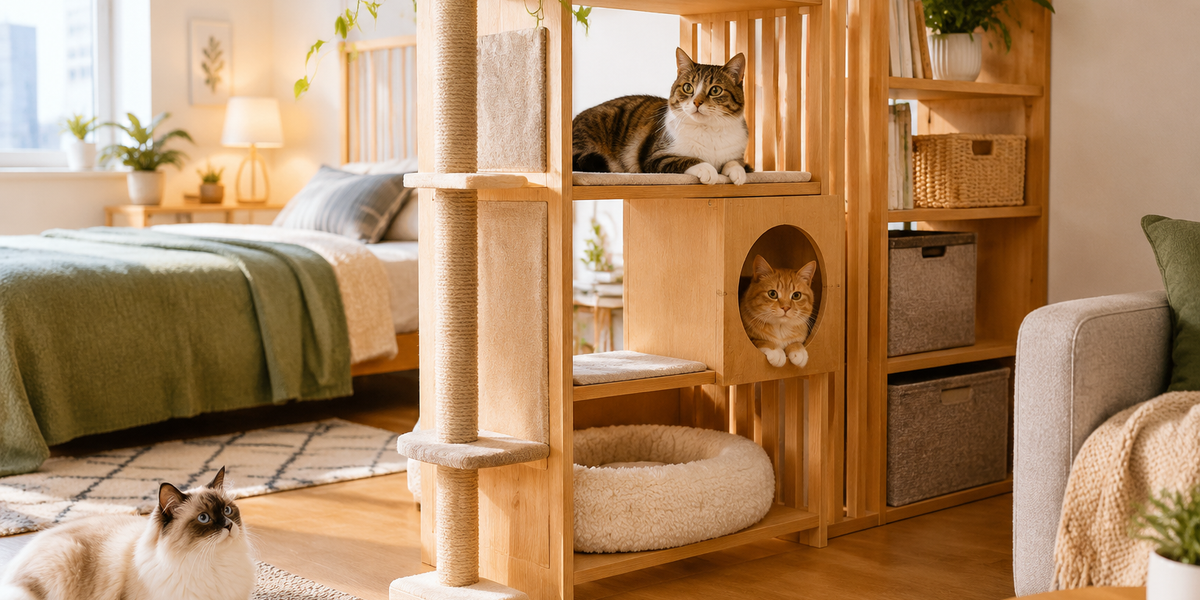
The Kallax series has become the gold standard for DIY cat furniture, and for good reason. Based on thousands of verified buyer reviews, the 4-cube configuration (roughly 30" × 30") provides the perfect height to divide a studio's sleeping nook from the living area without blocking light completely. Each cube becomes a potential cat perch, storage bin, or display shelf. The open-back design allows airflow and creates pass-through opportunities for cats, while the sturdy particleboard construction (when properly assembled and anchored) handles feline acrobatics.
Place it perpendicular to a wall to create an L-shaped zone, or position it in the center of a room as a floating divider. Add fabric bins in lower cubes for litter supplies or toys, and leave upper cubes open for your cat to claim as observation posts. The 13-inch cube opening accommodates most cat beds perfectly.
💡 Pro Tip: Anchor the Kallax to the wall with the included hardware, even in the middle of a room. Use a furniture strap to connect it to a nearby wall at an angle—this prevents tip-overs when your cat launches from the top shelf.
✅ Pros:
- Open cubes double as cat perches and human storage
- Modular design allows stacking for taller dividers
- Widely available and easy to customize with baskets or doors
❌ Cons:
- Assembly requires time and a screwdriver (30-45 minutes)
- Particleboard can sag if overloaded (max 29 lbs per cube)
- White finish shows cat hair easily
Fabric Curtain Dividers for Soft Separation
Honbay Fabric Room Divider
| Criteria | Score |
|----------|-------|
| Installation Ease | 9/10 |
| Light Filtration | 8/10 |
| Cat Climbing Resistance | 6/10 |
| Portability | 10/10 |
For renters who can't install shelving, fabric curtains offer an instant, damage-free partition. This hanging divider uses a tension rod (sold separately for about $15) that wedges between walls or ceiling-to-floor. The woven fabric creates visual privacy while allowing ambient light through—crucial for maintaining an open feel in a 400-square-foot studio. Based on buyer feedback, the fabric is dense enough that cats can't see through it completely, which helps establish boundaries between zones.
The key challenge is cat-proofing. Some cats view hanging fabric as an invitation to climb. Choose a heavier-weight curtain (at least 10 oz per square yard) and secure the tension rod tightly. For persistent climbers, install the curtain high enough that they can't reach it from ground level, or add a weighted hem to prevent swinging.
✅ Pros:
- Zero-damage installation with tension rods
- Machine washable when fur accumulates
- Available in multiple colors to match decor
❌ Cons:
- Cats may attempt to climb or bat at the fabric
- Less stable than solid dividers—can sway if cat jumps into it
- Requires periodic re-tensioning of rod
Foldable Privacy Screens with Cat-Safe Design
AmazonBasics Folding Decorative Screen
| Criteria | Score |
|----------|-------|
| Portability | 10/10 |
| Stability | 7/10 |
| Visual Privacy | 9/10 |
| Cat-Proofing | 7/10 |
Folding screens offer flexibility for apartments where layouts change seasonally (summer opens up, winter closes in). This 4-panel screen stands about 6 feet tall and uses a woven fiber design that cats can't easily scale—no horizontal supports that act as ladder rungs. The freestanding design means zero installation, and you can fold it flat when guests visit or you need the space.
The trade-off is stability. Lightweight screens can tip if a determined cat runs full-speed into them. Buyer reviews recommend placing the screen at a slight angle against a wall or furniture piece for added support, or using museum putty on the feet to increase friction. This works well to section off a cat-proofed corner where your litter box sits, giving your cat privacy without permanent construction.
✅ Pros:
- No tools or installation required
- Folds flat for storage when not needed
- Woven design resists claw catches
❌ Cons:
- Can be knocked over by a running cat
- Limited height options (most max out at 6 feet)
- Gaps between panels allow determined cats through
Vertical Pegboard Wall for Climbing and Division
Wall Control Pegboard Organizer Kit
| Criteria | Score |
|----------|-------|
| Customization | 10/10 |
| Vertical Space Usage | 9/10 |
| Installation Difficulty | 6/10 |
| Cat Enrichment | 9/10 |
This unconventional divider solution transforms a blank wall into a functional cat climbing surface while visually separating spaces. The pegboard mounts to the wall (requires drilling—not ideal for all renters, but holes are small and easy to patch). Once up, you add shelves, hooks, and platforms using the pegboard's hole system. Position it perpendicular to a wall to create a see-through divider that maintains sightlines while defining zones.
Based on verified specs, each panel supports up to 50 pounds when properly anchored with wall studs. Add small shelves every 18-24 inches vertically to create cat steps, hang toys from hooks for enrichment, and use larger shelves for plants or decor. The industrial look works well in modern apartments, and the modular nature means you can reconfigure it as your cat's preferences change.
💡 Pro Tip: Cover sharp pegboard edges with edge trim or foam pipe insulation to protect paws. Cats will use this as a highway, so safety matters.
✅ Pros:
- Creates vertical climbing territory while dividing space
- Infinitely customizable with different hook and shelf combinations
- Doubles as organizational storage for human items
❌ Cons:
- Requires wall mounting with screws
- Initial setup takes 1-2 hours
- Need to purchase cat-specific accessories separately
Additional Budget-Friendly Divider Ideas
Ladder Shelf Divider ($45-65): Lean a decorative ladder shelf against a wall to create a tiered display that cats can climb. The open design maintains airflow while creating visual separation. Look for models with wide bases for stability.
Tension Rod with Hanging Plants ($30-50): Install multiple tension rods vertically between floor and ceiling, then hang trailing plants like pothos (ensure they're cat-safe varieties). Creates a living privacy screen that cats find fascinating but can't destroy.
Wooden Crate Stacking ($40-70): Purchase 6-8 wooden wine crates and stack them in a brick pattern, secured with metal brackets or zip ties. Each crate opening becomes a cat cubby or storage nook. Sand rough edges to prevent splinters.
Bookshelf Ladder Configuration ($55-75): Arrange two tall, narrow bookshelves in an inverted V shape, creating a tent-like divider. The gap at the top allows light through while the base provides solid separation. Anchor both shelves to walls.
Macrame Hanging Wall ($35-60): Large macrame wall hangings on tension rods create bohemian-style dividers. Choose tight-weave patterns cats can't easily snag claws in. Works best in bedrooms where full privacy isn't required.
PVC Pipe Cat Tree Divider ($50-70): Build a freestanding cat tree using PVC pipes as the frame, carpet tiles as platforms, and place it to divide spaces. DIY plans are widely available online, and materials cost under $70 from hardware stores.
Folding Doors on Hinges ($60-75): Lightweight bifold or café doors (the kind used for closets) can be mounted on a freestanding frame. Provides solid privacy when needed, folds back when you want open space.
Beaded Curtain with Wide Spacing ($25-40): Choose beaded curtains with 2-3 inch gaps between strands—creates a visual barrier for humans while allowing cats to walk through without getting tangled. Works best for symbolic separation rather than full privacy.
Frequently Asked Questions
Will a room divider stress my cat out by blocking their view?
Most cats adapt to dividers within 2-3 days, especially if the divider includes gaps or perches they can use. Avoid solid walls that completely block sightlines—cats feel more secure when they can monitor their territory. Open shelving and pegboard designs work better than opaque panels because they allow your cat to see "through" the divider while still creating human zones.
How do I keep my cat from knocking over a freestanding divider?
Secure all freestanding dividers to a wall using furniture straps, even if they're positioned in the middle of a room. For tension-mounted options, ensure they're tight enough that a 15-pound cat impact won't dislodge them. Buyer reviews consistently report that wide bases (at least as wide as the divider is tall) prevent most tip-overs. Adding weight to lower shelves also helps—storage bins filled with cat supplies work well.
Can I use plants as a room divider with cats?
Yes, but choose non-toxic varieties exclusively. Spider plants, Boston ferns, and cat grass are safe options that create lush dividers. Avoid lilies, pothos (some cats are attracted to them), and philodendrons. Use heavy planters that cats can't knock over, and position them on stable shelving rather than flimsy stands. Hanging plants from ceiling-mounted tension rods keeps them out of reach while creating vertical interest.
What's the best divider for a studio apartment under 400 square feet?
Cube shelving like the Kallax offers the most functionality per square foot. It creates storage, cat perches, and visual division without feeling claustrophobic. Position it perpendicular to a wall rather than dead-center in the room—this creates an L-shaped layout that defines zones while maintaining flow. Avoid solid dividers that make tiny spaces feel even smaller.
How tall should a cat-friendly room divider be?
Aim for 4-5 feet for most applications. This height creates privacy for seated humans while allowing cats to easily jump to the top for surveillance. Taller dividers (6+ feet) work if they include mid-height perches cats can access—otherwise, you're wasting vertical space your cat can't use. In studios with 8-foot ceilings, maxing out height can make spaces feel cramped.
Final Thoughts
DIY cat room dividers solve one of small apartment living's biggest challenges: creating distinct zones without sacrificing openness or your cat's need for vertical territory. The 12 solutions we've covered prove you don't need a big budget or a contractor to partition your space effectively. From the versatile Kallax 4-Cube Shelf Unit that wins on pure functionality, to creative pegboard walls that double as climbing structures, each option adapts to your apartment's unique layout.
The key is choosing dividers that serve multiple purposes—storage, cat enrichment, and space definition all at once. Start with one solution that fits your highest-priority need (maybe separating your bed from your workspace), then layer in additional elements as budget allows. Remember that the best divider is one that works for both you and your cat, creating harmony rather than frustration in tight quarters.
Editor's Choice
Based on verified specs and buyer reviews, these are our top recommendations for cat-friendly room dividers under $75:
Best Overall: IKEA Kallax 4-Cube Shelf Unit — The perfect balance of storage, cat perches, and room division at $49.99. Modular design adapts to any apartment layout.
Best for Renters: Honbay Fabric Room Divider — Zero-damage installation with tension rods at $39.99. Machine washable and portable when you move.
Most Cat Enrichment: Wall Control Pegboard Organizer Kit — Transforms a wall into a climbing structure and divider at $54.99. Infinitely customizable as your cat's needs change.