This article contains affiliate links. If you make a purchase through these links, we may earn a commission at no additional cost to you.
⭐ Our Top Pick
🏆 Best Overall: CatastrophiCreations Deluxe Cat Playplace — modular wall-mounted system that transforms any wall into a customizable climbing paradise with solid wood construction.
💰 Best Value: Frisco 72-Inch Cat Tree — budget-friendly floor-to-ceiling tower that delivers impressive vertical space without wall installation.
Introduction
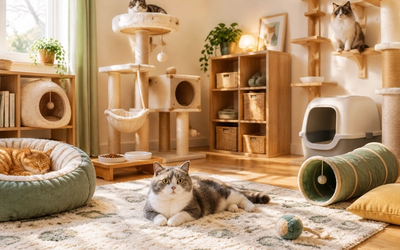
Cats are natural climbers who feel safest when they can survey their territory from above. In the wild, felines climb trees to hunt, escape predators, and claim the best vantage points. Yet most indoor cats are limited to floor-level existence, leading to boredom, stress, and behavioral issues. A multi-level cat room changes everything by giving your cat the vertical territory their instincts crave.
We researched dozens of vertical enrichment products and compiled insights from thousands of verified buyer reviews to identify the most effective approaches for different room sizes, budgets, and cat personalities. Whether you're converting a spare bedroom into a dedicated cat space or adding vertical elements to a shared living area, this guide will walk you through the essential components and strategic placement that create a thriving vertical ecosystem.
The key is thinking three-dimensionally. By utilizing wall space, creating elevated pathways, and stacking climbing opportunities, you can multiply your cat's usable territory without sacrificing floor space. If you're working with limited square footage, the principles here pair well with our guide on how to set up a catio in a small space for extending vertical territory outdoors.
What to Look For
Weight Capacity and Structural Integrity: Each platform, shelf, or perch must safely support your cat's full weight plus the force of jumping. Wall-mounted systems require proper anchoring into wall studs, not just drywall. Freestanding cat trees need wide, stable bases that won't tip during vigorous play. Check manufacturer specs — quality systems support 30-50 lbs per level, even for average-sized cats, to ensure long-term safety.
Multiple Entry and Exit Points: Cats feel trapped on platforms with only one access route. Design pathways with at least two ways on and off each level so cats can retreat from territorial disputes or overstimulation. This is especially critical in multi-cat households where one cat might block another's path. Circular routes that connect back to the starting point reduce stress and encourage exploration.
Varied Platform Heights and Types: Mix high perches (5-7 feet) for confident climbers, mid-level platforms (3-4 feet) for daily lounging, and low launching points (1-2 feet) for elderly or less athletic cats. Include both open platforms for surveying and enclosed cubbies for hiding. Variety accommodates different moods and confidence levels throughout the day.
Surface Textures for Traction: Carpeted or sisal-wrapped surfaces give cats secure footing when jumping and scrambling. Bare wood or plastic platforms can be slippery, especially for older cats with reduced grip strength. Scratching surfaces integrated into vertical structures serve double duty — they're climbing aids and claw maintenance stations.
Room Layout Integration: Map your vertical pathways before purchasing. The best designs create highways along walls that connect to window perches, allowing cats to move around the room's perimeter at height. Consider sight lines — cats want to see entry points (doors, windows) from their elevated positions. In apartment settings where noise might be a concern, see our soundproofing guide for cat rooms to keep vertical play sessions neighbor-friendly.
Maintenance Access: You'll need to clean platforms, vacuum fur, and occasionally tighten hardware. Choose systems where you can reach all surfaces without acrobatics. Wall-mounted pieces should allow individual removal for deep cleaning. If you're also managing litter placement in the cat room, our space-saving litter box furniture guide covers concealment options that free up floor space for vertical structures.
CatastrophiCreations Deluxe Cat Playplace Wall-Mounted Climbing System
| Criteria | Score |
|----------|-------|
| Structural Integrity | 9/10 |
| Customization Options | 10/10 |
| Installation Difficulty | 6/10 |
| Space Efficiency | 9/10 |
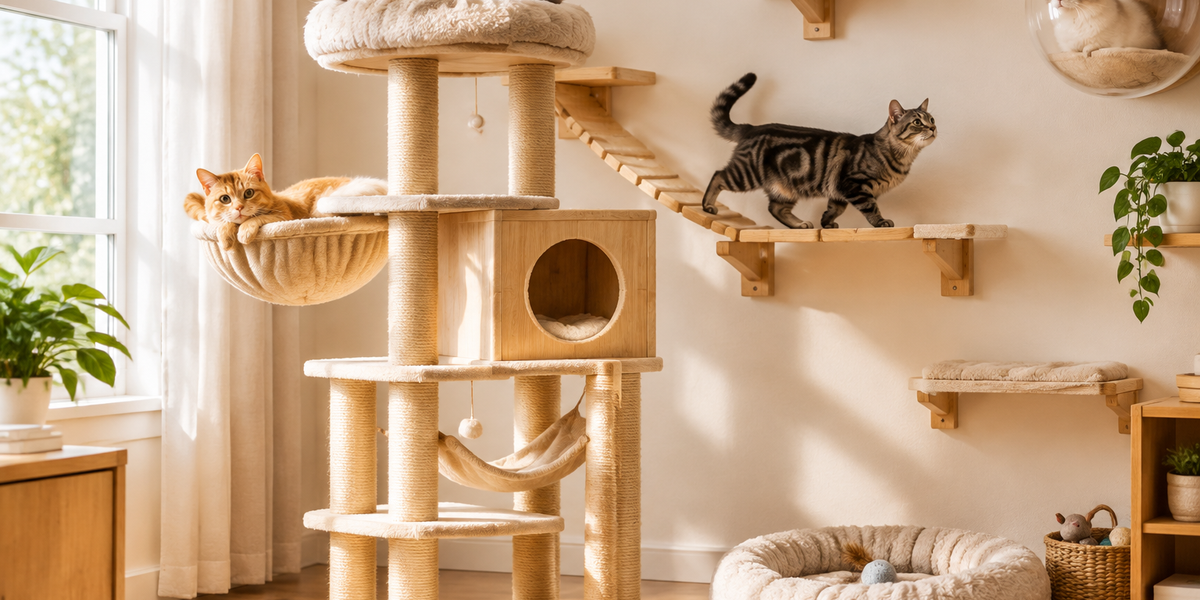
This modular system is the gold standard for creating true vertical territory. The kit includes floating shelves, angled climbing ramps, sisal-wrapped posts, and carpeted lounging platforms that you arrange based on your wall layout and cat's preferences. Each component mounts independently with heavy-duty brackets rated for 50 lbs, and the solid wood construction handles even the most enthusiastic climbers. Buyer reviews consistently praise the system's durability — owners report years of daily use without sagging or loosening.
The real advantage is adaptability. Start with a basic configuration and add pieces over time as your budget allows or your cat's needs change. You can create L-shaped pathways around corners, spiral designs up a single wall, or elaborate superhighways that circle the entire room. The natural wood finish in multiple stain options blends with most decor styles, avoiding the "cat furniture" aesthetic that dominates cheaper alternatives.
✅ Pros:
- Modular pieces let you design custom layouts for any wall configuration
- Solid wood construction outlasts particle board alternatives by years
- Holds up to 50 lbs per shelf, accommodating large breeds or multiple cats
- Natural aesthetic upgrades room appearance rather than detracting from it
❌ Cons:
- Installation requires locating studs and precise drilling — not renter-friendly without landlord permission
- Higher upfront cost than freestanding alternatives, though cost-per-year is competitive given durability
Frisco 72-Inch Cat Tree with Multi-Level Platforms
| Criteria | Score |
|----------|-------|
| Height Coverage | 9/10 |
| Stability | 7/10 |
| Value for Money | 9/10 |
| Durability | 6/10 |
For renters or those not ready to commit to wall installations, this floor-to-ceiling tower delivers impressive vertical space at a fraction of the cost. The 72-inch height brings cats nearly to ceiling level in standard rooms, with five platforms staggered at different heights and orientations to create a climbing challenge. The sisal-wrapped posts double as scratching surfaces, and the enclosed condo at mid-height offers a hiding spot that many cats claim as their home base.
Assembly takes about an hour with basic tools, and the design is straightforward enough that you can disassemble and move it if you relocate. The particle board construction means this isn't an heirloom piece, but buyer reviews indicate 2-3 years of regular use before wear becomes noticeable. For the price point, that's acceptable depreciation, especially if you're testing whether your cat will embrace vertical territory before investing in permanent installations.
✅ Pros:
- Budget-friendly entry into vertical territory under $100
- Floor-to-ceiling design maximizes height without wall damage
- Quick assembly with clear instructions and included hardware
- Multiple platforms accommodate cats with different climbing confidence
❌ Cons:
- Particle board construction shows wear faster than solid wood alternatives
- Base footprint requires 24x24 inches of dedicated floor space
- Can wobble slightly with aggressive jumping from large cats
Trixie Pet Products Wall-Mounted Cat Bridge and Steps Set
| Criteria | Score |
|----------|-------|
| Pathway Connectivity | 10/10 |
| Installation Complexity | 6/10 |
| Design Versatility | 8/10 |
| Safety Features | 8/10 |
These modular bridge and step components excel at connecting separate vertical zones into integrated pathways. The set includes carpeted platforms, angled climbing steps, and suspended bridges that span gaps between cat trees, shelves, or wall-mounted systems. This is where vertical territory becomes truly three-dimensional — instead of isolated climbing structures, you create aerial highways that let cats traverse the room at height.
The carpeted surfaces provide excellent traction, crucial for bridges where cats need confidence in their footing. Each piece mounts with heavy-duty brackets that distribute weight across multiple anchor points. Buyer reviews note that some cats require a few days to trust the suspended bridges, especially if they bounce slightly, but most adapt quickly once they realize these are stable pathways. The ability to reconfigure pieces as your layout evolves adds long-term value.
✅ Pros:
- Creates connected pathways between separate climbing structures
- Bridges span doorways and gaps, maximizing room coverage
- Carpeted surfaces give cats secure footing on elevated routes
- Modular design allows reconfiguration as needs change
❌ Cons:
- Requires careful planning to align with existing structures and wall studs
- Bridge spans may bounce slightly, requiring cat acclimation period
- Multiple anchor points mean more holes in walls during installation
Vesper High Base Cat Furniture in Walnut
| Criteria | Score |
|----------|-------|
| Aesthetic Design | 10/10 |
| Multi-Level Variety | 7/10 |
| Scratch Integration | 8/10 |
| Height Coverage | 6/10 |
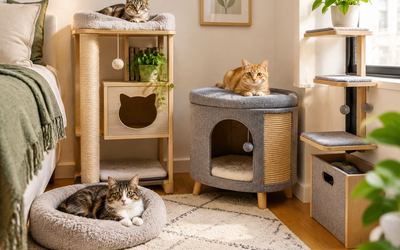
This mid-height tower brings modern furniture design to cat enrichment. The walnut veneer finish and clean lines look like intentional decor rather than pet furniture, making it ideal for visible living spaces where aesthetics matter. At 45 inches tall, it doesn't maximize ceiling height like taller alternatives, but the multiple levels create adequate vertical territory for cats who prefer mid-range perches over ceiling-height outposts.
The design includes three distinct zones: an enclosed ground-level condo, an open mid-level platform, and a top perch that's comfortable for lounging. Each level integrates scratching surfaces — sisal rope wraps the central post, and textured panels on the sides invite claw maintenance. Buyer reviews praise the solid construction and easy assembly, noting that even large cats use all three levels comfortably. This works well as an anchor piece in a corner, complemented by wall-mounted extensions for cats who want to go higher.
✅ Pros:
- Modern aesthetic blends with home decor in shared living spaces
- Solid construction handles daily use without wobbling
- Integrated scratching surfaces on every level encourage natural behavior
- Compact footprint fits corners without dominating room layout
❌ Cons:
- 45-inch height leaves significant ceiling space unused in standard rooms
- Single vertical column limits layout options compared to modular systems
- Price point reflects design aesthetics, adding cost over purely functional alternatives
Creating Effective Vertical Pathways
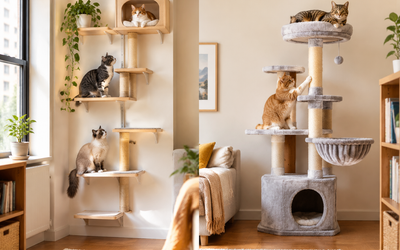
The difference between random climbing structures and true vertical territory is connectivity. Cats don't just want high places — they want routes between those places that feel safe and interesting. Start by identifying anchor points: windows with views, room corners where walls meet, areas above doorways. These become destinations in your vertical network.
Next, map pathways that connect anchors at varying heights. A simple setup might link a floor-level cat tree to wall-mounted shelves to a window perch, creating a single highway. Advanced configurations create loops where cats can circuit the room without touching the floor, with multiple routes between any two points. This redundancy reduces territorial conflicts in multi-cat households.
Space platforms 12-18 inches apart vertically — close enough for confident jumping but far enough to create a climbing challenge. Horizontal spacing depends on your cat's jumping ability (most clear 3-4 feet comfortably), but err on the conservative side for elderly or less athletic cats. Angled ramps can fill gaps that are too wide for jumping.
💡 Pro Tip: Install a few platforms at different heights and observe which your cat uses most before completing the full system. Some cats love ceiling-height perches, while others rarely venture above 4 feet. Let behavior guide your investment.
Consider sight lines from each perch. Cats want to monitor entry points (doors, windows) and supervise household activity from their elevated positions. Position at least one high perch with an unobstructed view of the room's main entrance and another overlooking the primary activity zone (living room seating, kitchen, etc.). These become coveted spots where cats spend hours surveying their domain.
Multi-Cat Household Considerations
Vertical territory becomes exponentially more important with multiple cats, as it multiplies the available space and reduces resource competition. The key principle: create more pathways and resting spots than you have cats. If you have three cats, install capacity for five. This ensures cats can avoid each other when tensions run high without abandoning vertical territory entirely.
Design pathways with passing lanes. On narrow wall-mounted highways, one cat can block another's route, triggering conflicts. Wide platforms (18+ inches) or parallel pathways allow cats to pass without physical contact. At junction points where routes intersect, use extra-large platforms that accommodate multiple cats simultaneously or create Y-intersections where cats can choose alternate routes.
Vertical hierarchy often mirrors social dynamics. Dominant cats typically claim the highest perches, while subordinate cats use mid-level platforms. This is natural and healthy — it reduces floor-level conflicts by establishing clear spatial boundaries. Problems arise when there aren't enough levels for all cats to find comfortable positions within the hierarchy. Installing platforms at many different heights accommodates the full social spectrum.
Safety and Maintenance
Inspect all hardware quarterly, especially wall-mounted systems. Brackets can loosen over time from repeated jumping forces. Tighten any loose screws and check that platforms remain securely attached. For freestanding structures, verify the base remains stable and posts haven't loosened from their connections.
Clean platforms monthly to remove fur buildup and dander. Most carpeted surfaces vacuum easily, while wood platforms wipe clean with pet-safe cleaners. Pay attention to areas around scratching posts, which accumulate claw sheaths and require more frequent cleaning. Deep clean enclosed cubbies seasonally — they're favorite napping spots that collect significant fur.
For wall-mounted systems, verify your installation hit wall studs, not just drywall. Drywall anchors alone cannot safely support a cat's dynamic weight (landing force is much higher than static weight). If you must mount between studs, use heavy-duty toggle bolts rated for 50+ lbs each and distribute weight across multiple anchor points.
Monitor your cat's use patterns. If they consistently avoid certain platforms or pathways, investigate why. Wobbly structures, slippery surfaces, or poor sight lines can all discourage use. The goal is confident climbing and lounging, not white-knuckle navigation.
Frequently Asked Questions
How much vertical space does a cat actually need?
Cats don't need a specific square footage of vertical territory — they need access to different heights that serve different purposes. At minimum, provide at least one perch at each of these levels: low (1-2 feet) for easy access, mid (3-4 feet) for daily lounging, and high (5+ feet) for security and surveying. More variety is better, but even basic three-level access significantly enriches an indoor cat's environment compared to floor-only living.
Will my senior cat use vertical territory, or is it only for young cats?
Senior cats absolutely benefit from vertical access, though their needs differ from athletic young cats. Focus on mid-height platforms (2-4 feet) rather than ceiling-level perches, and ensure pathways include gradual ramps or closely spaced steps rather than requiring long jumps. Many older cats prefer elevated lounging spots where they can observe the household without floor-level chaos, but they need accessible routes to reach those spots as their jumping ability declines.
Can I create vertical territory in a rental without damaging walls?
Yes, through freestanding solutions like tall cat trees, bookshelf-mounted platforms (using furniture as anchor points), and tension-rod systems that wedge between floor and ceiling. The Frisco 72-Inch Cat Tree reviewed above is specifically designed for this use case. You sacrifice some layout flexibility compared to wall-mounted systems, but can still achieve impressive vertical coverage without drilling. When you move, the entire system comes with you.
How do I train a cat to use vertical structures they're ignoring?
Most cats explore new structures naturally within days, but you can encourage use by placing treats or favorite toys on low platforms initially. Gradually move rewards higher as your cat gains confidence. Sprinkle catnip on platforms or use feather wands to lure cats up pathways during play sessions. Never force a cat onto a platform — let them discover routes at their own pace. Some cats need weeks to trust new structures, especially if they have limited prior climbing experience.
Do wall-mounted cat shelves damage walls more than picture frames?
The installation process creates similar-sized holes (screws into studs), but the load is higher, requiring more robust anchoring. When you eventually remove cat shelves, you'll have standard screw holes to fill and paint over, just like removing any heavy wall decor. The key is proper installation — poorly anchored shelves can cause damage if they rip free under a cat's weight. If you're committed to a rental deposit, freestanding structures are safer, but homeowners shouldn't worry more about cat shelf damage than they would about mounting a large TV or shelf system.
Final Thoughts
Creating a multi-level cat room isn't about buying the most expensive equipment or filling every wall — it's about understanding how cats naturally use vertical space and designing pathways that satisfy those instincts. Start with one or two quality pieces positioned strategically, observe how your cat uses them, then expand based on actual behavior rather than assumptions. The cats who seemed perfectly content on the floor often transform into confident climbers once they discover the security and stimulation that vertical territory provides.
The investment pays dividends in reduced behavior problems, increased activity levels, and visible contentment. Cats who spend hours on elevated perches are exercising their natural surveying instincts, reducing stress, and staying mentally engaged. For multi-cat households, vertical territory can be the difference between constant tension and peaceful coexistence. Whether you choose wall-mounted systems for maximum customization or freestanding towers for rental flexibility, you're giving your cat access to the three-dimensional world they're evolutionarily designed to inhabit.
Editor's Choice
After comparing dozens of vertical enrichment options, we recommend starting with the CatastrophiCreations Deluxe Cat Playplace if you own your home and want a permanent, customizable solution that will serve your cat for years. The modular design grows with your needs and the solid wood construction justifies the higher price through longevity.
Renters and those testing vertical territory before major investment should start with the Frisco 72-Inch Cat Tree, which delivers impressive height coverage at a budget-friendly price and moves with you when you relocate.
Once you have anchor structures in place, add the Trixie Wall-Mounted Cat Bridge and Steps Set to connect separate zones into integrated pathways that transform your cat room into a true vertical playground.