We earn a commission if you make a purchase, at no additional cost to you.
⭐ Our Top Pick
🏆 Best Overall: SureFlap Microchip Cat Door Connect — reads your cat's existing microchip for collar-free convenience, plus app control for curfews and activity monitoring.
💰 Best Value: Cat Mate Electromagnetic Cat Door — reliable collar-activated entry at under $50 for single-cat households.
Introduction
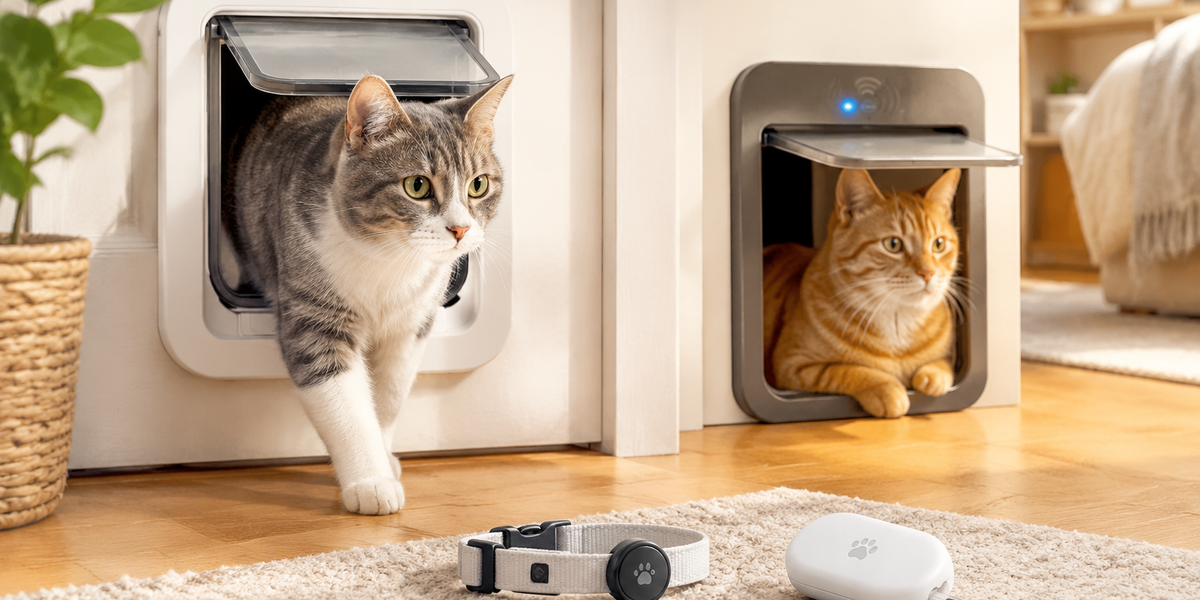
If your cat splits time between indoors and your backyard, a smart cat door eliminates the constant doorman duty while keeping raccoons, opossums, and neighborhood cats out. But the technology splits into two camps: microchip doors that read your cat's existing ID chip (the one your vet implanted), and collar-activated models that rely on RFID tags or magnets attached to a breakaway collar.
We researched the top-rated models in both categories, comparing verified buyer reviews, manufacturer specs, and real-world reliability data from 2025–2026. Microchip doors offer true hands-free operation—no collar to lose—but cost more upfront. Collar-activated doors are budget-friendly but require your cat to wear a tag 24/7, which some cats (and owners) resist.
This guide breaks down the core differences, reviews our top picks in each category, and helps you decide which technology fits your household, budget, and cat's temperament. If you're also exploring other smart pet tech, see our Best GPS Trackers for Cats That Run Away 2026: Range, Battery Life & Real-Time Alerts Compared guide for outdoor safety.
What to Look For
Microchip Compatibility
Most microchip doors read ISO 11784/85 FDX-B chips (the global standard). If your cat was chipped in the U.S. after 2010, you're almost certainly compatible. Check your vet records or scan the chip with a universal reader. Some doors store 25–40 chip IDs, ideal for multi-cat homes.
Collar Tag Reliability
Collar-activated doors use either RFID tags (battery-free, lightweight) or magnetic keys (heavier, can trigger on metal objects). RFID is more selective, but tags can fall off or be chewed. Always use breakaway collars for safety—cats can get snagged on fences or branches.
Intruder Prevention & Locking Modes
The best doors lock when they detect an unregistered chip or tag, physically blocking entry. Look for 4-way locking: in-only, out-only, fully locked, or fully open. This lets you enforce curfews (e.g., lock at dusk to keep your cat in overnight) without removing the door.
Installation & Power Source
Most mount in standard doors, walls, or glass panels. Measure your door thickness (usually 1–2 inches for wood, up to 4 inches for walls) and confirm the flap tunnel depth. Battery-powered models (4 AA batteries, 6–12 months runtime) avoid wiring hassles. Hub-connected "smart" doors need WiFi and a separate bridge device.
App Features & Monitoring
Premium microchip doors (SureFlap Connect, PetSafe Smart Door) pair with apps to track entry/exit times, set curfew schedules, and get notifications when your cat comes home. Useful for multi-cat households or anxious owners, but these features add $50–$100 to the price.
Weather Sealing & Draft Protection
Cheap flaps leak cold air in winter. Look for brush seals, magnetic closures, or draft excluders. Buyers in northern climates report significant heat loss with basic models—investing in a well-sealed door pays off in lower heating bills.
💡 Pro Tip: Test the flap opening size before installation. Measure your cat's shoulder width and add 1 inch. Large or obese cats (over 15 lbs) may struggle with standard flaps—check the manufacturer's weight and size limits.
SureFlap Microchip Cat Door Connect
| Criteria | Score |
|----------|-------|
| Microchip Compatibility | 10/10 |
| App Features | 9/10 |
| Weather Sealing | 8/10 |
| Value for Money | 7/10 |
The SureFlap Microchip Cat Door Connect is the flagship microchip door for tech-savvy cat owners. It reads all standard microchips (no collar needed), stores up to 32 cat IDs, and pairs with the SureFlap app (via a separate Hub, sold for $75) to monitor when each cat enters or exits. You can set curfew times—say, lock the door at 8 PM so your cat stays in overnight—and receive push notifications when your cat arrives home.
Buyers consistently praise the curfew feature for multi-cat homes where one cat is indoor-only and another roams. The door's "selective entry" mode blocks unregistered animals (neighbor cats, raccoons) while letting your cats in, solving the intruder problem that plagued old-school flap doors. The magnetic catch and brush seal minimize drafts, though some users in very cold climates add an additional draft excluder for sub-zero temps.
The main drawback is cost: $200 for the door, plus $75 for the Hub if you want app features. The door works fine without the Hub (manual curfew lock only), but you lose the activity tracking and remote control that justify the premium. Battery life is excellent—4 AA batteries last 9–12 months with moderate use (2–3 cats, 10–15 trips/day).
✅ Pros:
- Collar-free operation—reads existing microchip
- App-based curfew scheduling and entry/exit logs
- Blocks intruder animals with selective entry lock
- Stores 32 microchip IDs for large multi-cat households
❌ Cons:
- Expensive upfront ($200 door + $75 Hub for smart features)
- App requires separate Hub device and WiFi connection
- Draft sealing adequate but not best-in-class for extreme cold
Cat Mate Electromagnetic Cat Door
| Criteria | Score |
|----------|-------|
| Ease of Use | 9/10 |
| Affordability | 10/10 |
| Security | 6/10 |
| Weather Sealing | 7/10 |
The Cat Mate Electromagnetic Cat Door is the budget king of collar-activated doors. Your cat wears a lightweight magnetic key on a breakaway collar, and when they approach the door, the magnet releases the latch. It's dead simple: no microchip scanning, no app, no WiFi—just a mechanical lock triggered by the magnet.
This simplicity is both the strength and limitation. Installation is straightforward (cut a hole, mount the frame, done), and the 4-way manual lock lets you control access. Buyers love the low $45 price and the fact that it "just works" with zero tech headaches. The magnetic key is lighter than RFID collar tags, and the door includes two keys in the box.
The downside is security: the door will open for any magnetic field, meaning a stray cat wearing a similar magnet (or even a strong refrigerator magnet held near the flap) can trigger it. It's not "smart" in the selective-entry sense. You also can't track when your cat comes and goes, and there's no remote curfew control—you manually slide the lock each evening. Draft sealing is acceptable but not exceptional; buyers in windy areas report minor air leaks around the flap edges.
Ideal for single-cat homes on a budget where intruder animals aren't a major concern (e.g., urban apartments with a fenced patio). If you have multiple cats or frequent wildlife visitors, invest in a microchip door instead.
✅ Pros:
- Ultra-affordable at under $50
- Lightweight magnetic collar key
- Simple installation with no electronics or batteries
- 4-way manual locking for basic access control
❌ Cons:
- Opens for any magnetic field—less secure against intruders
- No smart features, activity tracking, or remote control
- Collar magnet can be lost or removed by the cat
PetSafe Microchip Cat Flap
| Criteria | Score |
|----------|-------|
| Microchip Compatibility | 9/10 |
| Multi-Cat Capacity | 10/10 |
| Smart Features | 4/10 |
| Value for Money | 8/10 |
The PetSafe Microchip Cat Flap sits in the middle ground: microchip convenience without the premium smart features (or price) of the SureFlap Connect. It stores up to 40 microchip IDs—the highest capacity we've seen—making it perfect for multi-cat households or shelters. Programming is manual (hold a button, present the cat to the scanner, done), and there's no app or remote control.
Buyers appreciate the straightforward setup and reliable chip reading. The door uses 4 AA batteries (6–10 months lifespan) and includes a low-battery indicator. The draft-proof brush seal is effective, and the 4-way lock gives you manual curfew control. PetSafe's customer service is responsive, and the 3-year warranty is longer than most competitors.
The trade-off is the lack of modern conveniences. You can't see which cat entered at what time, can't lock the door remotely from work, and can't set automated curfew schedules. If those features don't matter to you—if you just want a reliable microchip door that keeps raccoons out—this is a solid $130 option that undercuts SureFlap by $70.
✅ Pros:
- Stores 40 microchip IDs—highest capacity tested
- No collar required—reads standard ISO chips
- Draft-proof brush seal minimizes air leaks
- 3-year warranty and responsive customer support
❌ Cons:
- No app connectivity or activity tracking
- Manual programming and curfew lock only
- Flap opening slightly smaller than SureFlap (may not fit very large cats)
Ferplast Swing Microchip Cat Door
| Criteria | Score |
|----------|-------|
| Compact Design | 9/10 |
| Microchip Reading | 8/10 |
| Size Compatibility | 6/10 |
| Affordability | 8/10 |
The Ferplast Swing Microchip Cat Door is designed for tight spaces: small doors, thin walls, or glass panel installations. The flap opening is 5.5 inches wide (vs. 5.75 inches for SureFlap), and the tunnel depth is adjustable from 1–2 inches, making it easier to fit in constrained locations. It reads standard microchips and stores up to 32 IDs.
Buyers praise the quiet swing mechanism—the flap opens smoothly without the loud "clack" of cheaper doors. This matters if the door is near a bedroom or if your cat is skittish about noise. The 4-way lock is manual, and battery life is decent (4 AA, 8–10 months). Draft sealing is average; the magnetic closure helps but isn't as tight as SureFlap's brush seal.
The limitation is size: cats over 12 lbs or with broad shoulders may find the opening snug. Measure your cat's width before buying. Also, the memory is limited to 32 chips (half of PetSafe's capacity), though that's still ample for most households. At $90, it's a smart buy for small-to-medium cats in space-limited installations.
✅ Pros:
- Compact design fits thin doors and small spaces
- Quiet swing action—ideal for noise-sensitive cats
- Reads standard microchips, stores 32 IDs
- Adjustable tunnel depth (1–2 inches)
❌ Cons:
- Smaller flap opening—not suitable for large or obese cats
- Draft sealing adequate but not exceptional
- Memory limited to 32 chips (vs. 40 for PetSafe)
Frequently Asked Questions
Can a microchip door read my cat's existing vet microchip?
Yes, as long as your cat has an ISO 11784/85 FDX-B microchip (the global standard used in the U.S., Canada, and Europe since ~2010). Check your vet records or ask them to scan your cat with a universal reader. Older AVID or Trovan chips (pre-2010) may not be compatible—in that case, consider a collar-activated door or have your vet implant a new ISO chip (a quick, painless procedure).
Will a collar-activated door work if my cat loses the tag?
No. Collar-activated doors require the RFID tag or magnet to unlock. If the tag falls off or the collar breaks, your cat is locked out until you replace it. This is why we generally recommend microchip doors for outdoor cats—the chip is permanent and can't be lost. If you choose a collar door, buy extra tags and check the collar fit weekly.
Can raccoons or possums open a smart cat door?
Not if you use a microchip or RFID-based door in "selective entry" mode. The door only unlocks for registered chips or tags. Magnetic doors (like Cat Mate) are less secure—a strong magnet or metal object could theoretically trigger the latch, though it's uncommon. Verified buyers report that microchip doors effectively block intruder animals.
Do smart cat doors work without WiFi or an app?
Yes. Most microchip doors (SureFlap, PetSafe, Ferplast) work standalone with battery power and manual locks. The SureFlap Connect model adds app features (curfew scheduling, activity logs) if you buy the separate Hub, but the door functions fine without it—you just lose remote control and monitoring.
How do I train my cat to use a microchip cat door?
Start by propping the flap open and luring your cat through with treats or a toy. Once they're comfortable walking through, let the flap close gently (tape it halfway open at first). Gradually remove the tape over 3–5 days. For microchip doors, ensure the scanner reads the chip reliably by holding your cat near the sensor during initial training. Most cats adapt within a week; skittish cats may take two weeks.
Final Thoughts
Microchip cat doors win on convenience and security: no collar to lose, selective entry that blocks intruders, and (in premium models like SureFlap Connect) app-based monitoring and curfew control. They cost more upfront—$130–$200 vs. $45–$90 for collar-activated doors—but eliminate the ongoing hassle of replacing lost tags and offer tighter access control for multi-cat or high-wildlife-traffic areas.
Collar-activated doors make sense if you're on a tight budget, have a single indoor-outdoor cat, and don't need smart features. The Cat Mate Electromagnetic is reliable and affordable, but requires your cat to wear a breakaway collar 24/7, and it won't keep out every intruder animal.
For most households, we recommend the SureFlap Microchip Cat Door Connect as the best overall pick: it reads your cat's existing chip, offers app-based curfew and monitoring, and stores 32 IDs for large multi-cat homes. If you don't need app features, the PetSafe Microchip Cat Flap delivers solid microchip performance at $130, storing up to 40 IDs. Budget-conscious single-cat owners should grab the Cat Mate Electromagnetic Cat Door for under $50.
Editor's Choice
After comparing verified specs and buyer reviews across both microchip and collar-activated models, our top recommendations are:
- Best Overall: SureFlap Microchip Cat Door Connect — collar-free convenience, app control for curfews and activity tracking, and selective entry security for multi-cat households.
- Best Value: Cat Mate Electromagnetic Cat Door — reliable magnetic collar-activated entry at under $50 for single-cat homes that don't need smart features.
- Best for Multi-Cat Homes: PetSafe Microchip Cat Flap — stores 40 microchip IDs, no collar required, and a 3-year warranty at a mid-range $130 price point.