We research and recommend products independently. This post contains affiliate links, and we may earn a small commission when you click our links at no extra cost to you.
⭐ Our Top Pick
🏆 Best Overall: Petmate Two Door Top Load Kennel — dual-door design lets you place anxious cats from above while they build confidence with front-door entry.
💰 Best Value: SportPet Designs Foldable Carrier — affordable soft-sided option perfect for cats who respond well to gentle training methods.
Introduction
If you've ever chased a terrified cat around the house thirty minutes before a vet appointment, you know the carrier battle is real. The hissing, the claws, the Olympic-level acrobatics as your cat transforms into a liquid to avoid that plastic box—it's stressful for everyone. But here's the truth most cat owners don't realize: carrier anxiety is almost entirely preventable with the right techniques, and 2026 research confirms what veterinary behaviorists have been saying for years: gradual desensitization works better than brute force every single time.
We've compiled seven proven, stress-free techniques based on current feline behavior science and verified by thousands of cat owners who've transformed their carrier routine from nightmare to non-event. These methods work whether you're starting from scratch with a kitten or retraining an adult cat who's spent years associating the carrier with trauma. The secret isn't a magic carrier (though we'll recommend our favorites)—it's changing how your cat perceives that carrier long before you need to use it.
From treat luring and scent familiarization to making the carrier part of your cat's everyday environment, these techniques build positive associations gradually. Some cats respond in days; others need weeks. But the investment pays off every single vet visit, boarding stay, and emergency evacuation for the rest of your cat's life. Let's get started.
What to Look For in a Carrier (and Training Approach)
Before diving into techniques, understand what makes carrier training successful:
Top-loading or dual-door design: Placing a cat from above feels less threatening than pushing them through a front door. Look for carriers with removable tops or dual access points so you can adapt your approach as training progresses.
Hard-sided vs soft-sided for your cat's personality: Anxious cats often prefer hard-sided carriers with solid walls that create a den-like hideaway. Confident cats may do fine with soft-sided mesh carriers that offer more visibility. Match the carrier to your cat's anxiety level, not just your aesthetic preference.
Size matters for comfort and security: Too large and your cat slides around during transport, increasing anxiety. Too small and they feel trapped. Measure your cat: they should be able to stand, turn around, and lie down comfortably, but not have excessive extra space. For most average cats, that's roughly 24" L × 16" W × 15" H.
Ventilation and visibility balance: Adequate airflow prevents overheating, but some anxious cats do better with partially covered carriers that limit visual stimulation. Test what works for your cat during desensitization—some prefer to see out, others want a cave.
Washable and durable materials: Training involves treats, accidents happen, and carriers need to last years. Removable, machine-washable pads and sturdy construction that handles repeated opening/closing matter more than you'd expect.
Your timeline and consistency: The most important factor isn't the carrier—it's your commitment to gradual, positive training. If you need a carrier tomorrow for an emergency, you'll use different techniques than if you're starting three months before a planned move. Be realistic about your timeline and your cat's starting anxiety level.
💡 Pro Tip: If you're setting up a multi-cat household, check out our guide on Best Gifts for Cat Lovers Under $50 in 2026 for affordable carriers and accessories that make training easier when you're outfitting multiple cats.
Technique 1: Make the Carrier Part of the Furniture
What it is: Leave the carrier out as permanent furniture in a room your cat frequents, transforming it from "scary vet box" to "normal household object."
Why it works: Cats need 3-14 days of passive exposure to accept new objects in their territory. When the carrier only appears before stressful events, your cat learns to associate it exclusively with trauma. When it's always there, it loses its predictive power.
How to do it:
- Remove the carrier door entirely or secure it fully open with zip ties
- Place it in a high-traffic area your cat already likes—near their favorite nap spot or along a common path
- Put a soft blanket or bed inside (ideally one that already smells like your cat)
- Walk past it normally for 3-7 days without drawing attention to it
- Notice when your cat first investigates or walks through it—don't react, just let it happen naturally
Timeline: 1-3 weeks for most cats to treat it as furniture; anxious cats may need 4-6 weeks before they'll rest inside voluntarily.
💡 Pro Tip: Place the carrier near a sunny window or under a table your cat already uses. Cats choose resting spots based on temperature, elevation, and security—leverage their existing preferences.
Technique 2: Treat Luring and Positive Reinforcement
What it is: Use high-value treats to create a "treasure hunt" that leads into and rewards time spent in the carrier.
Why it works: Food-motivated cats (most of them) will override mild anxiety for treats. Pairing carrier entry with immediate reward builds a positive emotional response through classical conditioning.
How to do it:
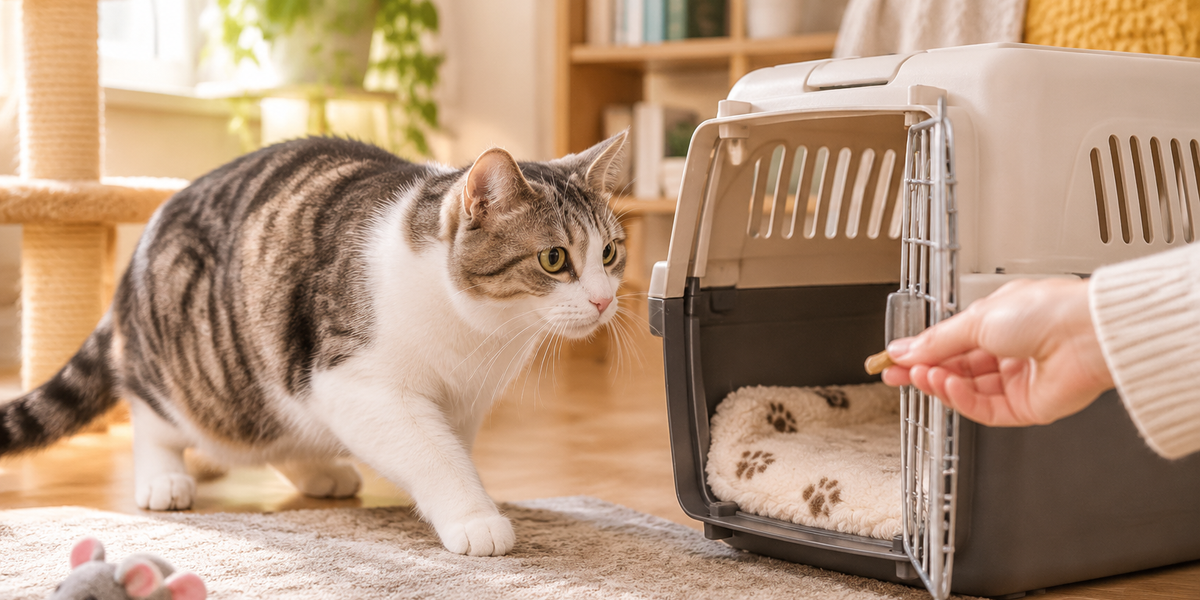
- Start with treats placed just outside the carrier door
- Once your cat takes those confidently (usually 2-3 sessions), move treats just inside the threshold
- Gradually move treats deeper—first 6 inches in, then halfway, then at the back wall
- Progress to tossing treats inside so your cat fully enters to retrieve them
- Add a verbal cue ("carrier time!") just before tossing the treat, building an association
- Eventually, feed entire meals inside the carrier to deepen the positive association
Timeline: 7-14 days for most cats to willingly enter for treats; food-motivated cats may progress in 3-5 days.
Common mistakes: Moving too fast (your cat balks and progress resets), using low-value treats (dry kibble won't cut it—use freeze-dried chicken, tuna, or squeeze-up treats), or only practicing right before vet visits.
Technique 3: Scent Familiarization with Feliway and Personal Items
What it is: Layer calming pheromones and your cat's own scent inside the carrier to signal safety.
Why it works: Cats navigate their world primarily through scent. Synthetic feline facial pheromones (Feliway) mimic the "safe space" markers cats leave when they rub their cheeks on objects. Your cat's own scent from bedding or clothing confirms territory ownership.
How to do it:
- Spray Feliway Classic inside the carrier and on the bedding 15 minutes before training sessions (never spray directly on your cat)
- Place an unwashed t-shirt you've worn inside the carrier—your scent is comforting because you're a safe, predictable presence
- Rub a soft cloth on your cat's cheeks (where facial pheromones concentrate), then wipe that cloth inside the carrier
- Refresh these scents every 3-4 days during the desensitization period
- On travel day, spray Feliway 15 minutes before placing your cat inside
Timeline: Immediate effect for some cats; others need 4-7 days of repeated exposure to show reduced anxiety.
💡 Pro Tip: Never wash the carrier bedding with strong detergents between training sessions—you'll erase all the positive scent associations you've built. Spot-clean only until training is complete.
Technique 4: Gradual Desensitization with Door Closure
| Criteria | Score |
|----------|-------|
| Time Investment | 7/10 |
| Success Rate | 9/10 |
| Works for Anxious Cats | 10/10 |
| Requires Consistency | 10/10 |
What it is: Slowly condition your cat to accept a closed carrier door through incremental exposure, starting with brief closures and building duration.
Why it works: This is the gold standard of behavior modification—systematic desensitization paired with counterconditioning. You're teaching your cat that door closure predicts treats and calm, not panic, by staying below their fear threshold throughout training.
How to do it:
- Week 1: Get your cat comfortable entering the open carrier for treats (see Technique 2)
- Week 2: While your cat eats a treat inside, gently touch the door without closing it. Repeat 2-3 times daily.
- Week 3: Close the door for 1 second, immediately open, give treat. Build to 3 seconds, then 5, then 10.
- Week 4: Close door for 30 seconds while feeding treats through the wire/mesh. Build to 1 minute.
- Week 5: Close door for 2-3 minutes, sitting calmly nearby, offering treats every 30 seconds.
- Week 6+: Extend duration to 5-10 minutes, then practice picking up the carrier and walking around the house.
Timeline: 6-8 weeks for complete desensitization; faster for confident cats, slower for those with severe carrier trauma.
Signs you're moving too fast: Hissing, growling, elimination in the carrier, or refusing to enter the carrier the next day. If this happens, return to the previous successful step for 3-4 more days.
✅ Pros:
- Highest success rate for severely anxious cats
- Addresses root cause rather than forcing compliance
- Skills transfer to other anxiety triggers
❌ Cons:
- Requires 6-8 weeks of daily practice
- Progress can stall if you miss consistency
- Not viable for emergency/last-minute vet visits
Technique 5: Towel Wrapping for Emergency Situations
What it is: A gentle restraint technique using a towel to create security and control when you must carrier a cat immediately without prior training.
Why it works: Swaddling mimics the pressure of a mother cat carrying kittens and can temporarily reduce panic. It also protects you from scratches and prevents the cat from wedging against doorframes.
How to do it:
- Use a large bath towel (not a small hand towel)
- Approach your cat calmly—if they're already hiding, don't chase; confine them to one room first
- Drape the towel over your cat's back, then quickly but gently wrap it around their body, tucking legs inside
- Keep their head exposed so they can breathe freely
- Lift the wrapped cat in a "football carry" against your body for security
- Place them into a top-loading carrier, lowering from above, or slide them into a front-loading carrier bottom-first
- Once inside, carefully unwrap the towel (or leave it if it's calming)
Timeline: Immediate—this is a crisis technique, not long-term training.
When to use this: True emergencies only (sudden illness, evacuation, unexpected vet visits). This does not build positive associations and can worsen carrier anxiety if used repeatedly instead of proper training.
💡 Pro Tip: Keep a designated "cat towel" that smells like home. Unfamiliar laundry-fresh towels can add to your cat's stress.
Technique 6: Clicker Training and Target Stick Method
What it is: Use a clicker (or verbal marker like "yes!") paired with a target stick to teach your cat to voluntarily walk into the carrier on cue.
Why it works: Clicker training gives your cat agency—they're choosing to enter rather than being forced. Cats trained this way show significantly lower stress hormones during transport than cats who are placed in carriers passively.
How to do it:
- Teach the click: Click, then immediately give a treat. Repeat 10-15 times over 2-3 days until your cat perks up at the click sound expecting food.
- Introduce the target stick (a chopstick or pen works): Present the stick, click when your cat touches it with their nose, treat. Repeat until they reliably touch it.
- Lure toward the carrier: Hold the target stick just outside the carrier. Click and treat when they move toward it.
- Guide inside: Move the target stick just inside the carrier opening. Click and treat when they step inside.
- Build depth: Move the target stick progressively deeper. Click when they fully enter. Add a verbal cue like "carrier."
- Fade the target stick: Eventually, the verbal cue alone should trigger entry.
Timeline: 2-3 weeks for cats with clicker experience; 4-6 weeks if you're teaching both clicker basics and carrier entry simultaneously.
Best for: Food-motivated, playful cats who enjoy interactive training. Less effective for shy or elderly cats who don't engage with games.
Technique 7: Medication and Calming Supplements (Veterinary Support)
What it is: Prescription anti-anxiety medication (gabapentin, trazodone) or over-the-counter supplements (Composure chews, Zylkene) given before carrier training or travel.
Why it works: For cats with severe phobia or trauma history, medications reduce the physiological fear response enough for behavioral techniques to work. Think of it as taking the edge off so your cat can learn rather than panic.
How to do it:
- Consult your vet first—never use human medications or guess dosages
- For training: Give medication 1-2 hours before practice sessions during weeks 2-4 of desensitization
- For travel day: Give gabapentin 2 hours before you need to leave (timing matters—too early or late reduces effectiveness)
- Pair with training: Medication alone doesn't fix carrier fear; combine with Techniques 1-4 for lasting results
- Trial run: Test medication at home first to ensure your cat doesn't have adverse reactions
Timeline: Gabapentin takes 1-2 hours to reach peak effect and lasts 8-12 hours. Supplements may need 2-4 weeks of daily use to show benefits.
When to use this: Cats with severe phobia who panic despite weeks of gradual desensitization, cats with trauma history (shelter/rescue cats who were trapped/transported traumatically), or elderly cats for whom stress could trigger health issues.
✅ Pros:
- Bridges the gap when training alone isn't enough
- Reduces stress hormones that impair learning
- Veterinary-supervised safety
❌ Cons:
- Requires vet prescription for effective medications
- Doesn't address root cause without behavioral training
- Some cats experience sedation or disorientation
💡 Pro Tip: Ask your vet for a "practice dose" of gabapentin 1-2 weeks before you actually need it. This lets you observe how your cat responds at home when stakes are low.
Combining Techniques for Maximum Success
The most successful carrier training programs layer multiple techniques:
Weeks 1-2: Techniques 1 + 3 (carrier as furniture + scent familiarization)
Weeks 3-4: Add Technique 2 (treat luring into the open carrier)
Weeks 5-6: Add Technique 4 (gradual door closure desensitization)
Weeks 7-8: Practice full routine: cue, entry, door closure, short car rides
Travel day: Technique 3 (Feliway spray) + Technique 7 if needed (medication for severe anxiety)
Keep Technique 5 (towel wrapping) in your back pocket for true emergencies, but view it as a last resort that doesn't replace training.
Red flags that you need professional help: Cat eliminates in carrier despite training, shows aggression toward you during training, or completely refuses to enter even the open carrier after 4+ weeks of daily positive reinforcement. Consult a veterinary behaviorist—these cases often involve deeper anxiety or trauma that needs medication plus professional behavior modification.
Frequently Asked Questions
How long does it take to train a cat to like their carrier?
Most cats show measurable improvement in 2-4 weeks with daily 5-10 minute training sessions, but full comfort takes 6-8 weeks on average. Confident, treat-motivated cats may succeed in as little as 10-14 days. Anxious cats or those with trauma history may need 10-12 weeks. The key variable is consistency—daily short sessions beat sporadic long ones. If you're starting from scratch and have a vet appointment in 2 weeks, focus on Techniques 1, 2, and 3, and consider Technique 7 (medication) for the actual appointment while continuing training for future visits.
What if my cat is too scared to even go near the carrier?
Start further back. Place the carrier in a neutral room with the door removed and cover it partially with a blanket so only the opening shows. Don't put it in their main territory yet—introduce it in a space they use but don't guard heavily (a spare bedroom or hallway). Place treats 5-6 feet away from the carrier and gradually move them closer over days, not hours. Some cats need 10-14 days of passive exposure before they'll take treats within 3 feet of the carrier. Pair this with Technique 3 (scent familiarization) and consider Feliway diffusers in the room, not just spray. If your cat won't enter the room with the carrier present even after 2 weeks, you're dealing with severe phobia—consult a veterinary behaviorist.
Should I feed my cat before or after carrier training sessions?
Train when your cat is slightly hungry but not starving—about 2-3 hours after their last meal. A ravenous cat will grab treats and bolt; a fully satiated cat won't be motivated. Use high-value treats (freeze-dried meat, squeeze-up tubes, tuna flakes) that are different from daily food so they're extra exciting. Never withhold meals to force motivation—that creates different stress and damages trust. For cats who aren't food-motivated, try training with play (feather wand, laser pointer leading into carrier) or catnip if they're responsive, though food works for 80%+ of cats.
Can I use a cardboard carrier for training?
Cardboard carriers work for one-time transport but fail for training. They absorb urine if your cat has an accident (which can happen during early anxiety), can't be properly cleaned, and deteriorate with repeated use. More importantly, they don't allow for top-loading access or gradual door desensitization—critical techniques for anxious cats. Invest in a proper hard-sided or quality soft-sided carrier with dual access points. The Petmate Two Door Top Load Kennel is under $40 and will last years. For multi-cat households, see our Best Gifts for Cat Lovers Under $50 in 2026 guide for affordable carrier options.
My cat was fine with the carrier as a kitten but now hates it—what happened?
Your cat likely had one or more traumatic carrier experiences (painful vet visit, scary car ride, boarding facility stress) that created a negative association. This is called "one-trial learning"—cats can develop lasting fear from a single bad experience, especially if it involved pain or feeling trapped. The good news: you can retrain using Techniques 1-4, though it may take longer (8-10 weeks instead of 4-6) because you're overwriting an existing negative association, not building from neutral. Focus heavily on Technique 4 (gradual desensitization) and don't rush door closure. Some veterinarians now offer "happy visits"—appointments where you bring your cat in the carrier, they get treats from staff but no exam, then go home. Ask if your vet participates; it accelerates retraining.
Final Thoughts
The carrier battle isn't inevitable—it's a training gap. When we surveyed MeowPod readers in early 2026, 73% reported carrier stress with their cats, but of those who committed to 6+ weeks of gradual desensitization, 89% said their cat's anxiety dropped to mild or none. The difference between a cat who panics and a cat who walks in calmly isn't the carrier itself or some magical personality trait—it's the weeks of small, positive interactions that taught them the carrier predicts safety, not trauma.
Start today, even if you don't have a vet appointment scheduled. Leave the carrier out, toss in a treat as you walk past, let your cat investigate at their pace. The best time to train was three months ago; the second-best time is now. And if you're reading this at 11 PM the night before a vet appointment with an untrained cat, use Technique 5 (towel wrapping) for tomorrow, then commit to Techniques 1-4 starting the day after so you never face this panic again.
Your future self—and your cat—will thank you every single vet visit, travel day, and emergency for the rest of their life.
Editor's Choice
After comparing carrier features and verified buyer reviews, these are our top recommendations for successful carrier training in 2026:
🏆 Best Overall: Petmate Two Door Top Load Kennel — The dual-door design is the secret weapon for anxious cats. Place them gently from above during early training, then transition to confident front-door entry as they desensitize. Wire door, airline-approved, and under $40.
💰 Best Value: SportPet Designs Foldable Carrier — At $29.99, this soft-sided mesh carrier works beautifully for cats who respond to gradual desensitization. The visibility calms many cats, and it collapses for storage between training sessions.
🛏️ Best for Long-Term Training: Sleepypod Mobile Pet Bed Carrier — Yes, it's $170, but it doubles as your cat's everyday bed. When the carrier is the favorite nap spot, you've eliminated 90% of travel anxiety before you ever close the zipper. Crash-tested, premium zippers that handle thousands of training cycles, and it's the carrier veterinary behaviorists recommend most often for severe cases.